


On this page
A 20,000-lumen light bar can be out-thrown by a 4,000-lumen spot lamp, because the distance a lamp reaches is set by peak intensity in candela, not by total flux in lumens. Two lamps with identical lumen figures can differ by three times in useful reach, and no single number printed on the box tells you which is which.
A light bar beam distance figure is therefore never a property of the lamp alone. It is a property of the lamp, the beam shape, and the illuminance threshold somebody chose to define “reaches” — which is why the same lamp can honestly be described as a 300-meter lamp, a 600-meter lamp or a 1,200-meter lamp depending on whether the seller means 5 lux, 1 lux or 0.25 lux at the end of the tape. This guide gives you the arithmetic to convert between those three numbers, the test criteria that real institutions actually use, and a short audit routine for any claimed throw, so that the figure you buy against is one you can check yourself.
The method needs only a calculator and, if you want to verify a lamp you already own, a lux meter. Every conversion in this article is either taken from a published definition or derived in front of you; the totals that depend on an assumption are labeled as assumptions.
Quick answer: match candela to the distance you need
The one-line answer: decide the distance you must see at, decide the illuminance you want there, then multiply. Peak intensity in candela equals target illuminance in lux multiplied by the square of the distance in meters, so 1 lux at 100 m needs 10,000 cd, 0.25 lux at 100 m needs 2,500 cd, and 1 lux at 200 m needs 40,000 cd. Those three numbers are arithmetic, not manufacturer claims.
That single multiplication replaces most of the debate. If a seller publishes peak intensity, you can price a lamp against your own requirement in ten seconds. If a seller publishes only lumens, you cannot do the calculation at all, because flux without a beam angle has no direction in it and therefore no distance.
| Distance you need light at | 5 lux needs | 1 lux needs | 0.25 lux needs |
|---|---|---|---|
| 25 m | 3,125 cd | 625 cd | 156 cd |
| 50 m | 12,500 cd | 2,500 cd | 625 cd |
| 100 m | 50,000 cd | 10,000 cd | 2,500 cd |
| 150 m | 112,500 cd | 22,500 cd | 5,625 cd |
| 200 m | 200,000 cd | 40,000 cd | 10,000 cd |
| 300 m | 450,000 cd | 90,000 cd | 22,500 cd |
Read the table from the bottom up as a sanity check on marketing. A lamp advertised as reaching 300 m at 1 lux is claiming roughly 90,000 cd on axis; at 0.25 lux the same claim implies only 22,500 cd. Two very different lamps hide behind one sentence.
What lumens, candela and lux measure
The three units answer three different questions, and the definitions are not matters of opinion. The International Lighting Vocabulary defines the lumen as the SI unit of luminous flux, equal to the flux of a monochromatic beam at 540 × 10¹² Hz whose radiant flux is 1/683 W, and equivalently the flux emitted in unit solid angle by a uniform point source of 1 candela (CIE 17-21-084). It defines luminous intensity as the density of luminous flux with respect to solid angle in a specified direction, expressed in candela, with cd = lm·sr⁻¹ (CIE 17-21-045). It defines the lux as the SI unit of illuminance, where 1 lx is the illuminance produced on a surface of 1 m² by a luminous flux of 1 lm uniformly distributed over that surface (CIE 17-21-085).
| Quantity | Unit | Symbol | What it describes | The buying question it answers |
|---|---|---|---|---|
| Luminous flux | lumen | lm, cd·sr | Total light leaving the lamp | How much light is available in total |
| Luminous intensity | candela | cd, lm/sr | Light per unit solid angle in one direction | How far the lamp can push light that way |
| Illuminance | lux | lx, lm/m² | Light arriving on a surface | How much light is on the road at that spot |
| Luminance | candela per m² | cd/m² | Light leaving a surface | Not used in this guide |
The same vocabulary entry gives the conversion that matters to anyone reading American data sheets: one footcandle equals 10.764 lux, so 1 lux is about 0.093 fc and 5 lux is about 0.46 fc. A specification written as “10 fc at 20 feet” is therefore about 107.6 lux at 6.1 m, which back-calculates to roughly 4,000 cd.
The candela itself is fixed by a defined constant rather than by a physical candle. NIST describes it as the luminous efficacy of monochromatic radiation at 540 × 10¹² Hz taken as exactly 683 lm/W, with the standard luminous efficiency curve V(λ) defined from 360 nm to 830 nm and peaking at 555 nm (NIST, SI Units – Luminous Intensity). That matters for one practical reason: a lamp’s luminous flux is weighted by human sensitivity, so two lamps with the same radiometric power but different spectra will not have the same lumen figure, and a lamp’s lumen number cannot be converted to candela without knowing how the light is distributed.
The inverse square law: one equation, three rearrangements
NIST states the relation in the form it actually uses in the laboratory: for a light source measured with a photometer at a distance d, the luminous intensity follows from the inverse square law as I_v = E_v·d²/Ω₀, where Ω₀ is the unit solid angle of one steradian (NIST, Realization of the candela). Rearranged for shopping, the same statement gives three tools.
E = I / d²tells you the illuminance a known lamp produces at a chosen distance.I = E · d²tells you the intensity required to hit a chosen illuminance at a chosen distance.d = √(I / E)tells you how far a known lamp holds a chosen illuminance.
NIST’s companion page on related photometric units shows the same d² dependence from the other side: the luminance of a calibrated sphere source is obtained from the illuminance measured 2.45 m away, the distance, and the aperture area, as L = E·d²/A (NIST, Realization of related photometric units). Working photometry runs on this relation in both directions, which is the strongest argument for using it as your buying arithmetic.

The law has boundaries that matter more in vehicle lighting than in a laboratory. It assumes a point source, and the vocabulary entry for luminous intensity says explicitly that for practical realization the source is approximated by a point source (CIE 17-21-045). At a distance comparable to the width of a 40-inch bar, that approximation is poor: a 1 m wide bar measured at 2 m is not a point, and the numbers near the bumper will not follow the equation. It also assumes no obstruction, no reflection and no atmospheric scattering. Fog, dust and heavy rain add scattering that both dims the beam and produces backglare, and none of that appears in a clean-air calculation.
Where the law does hold — from a few meters out to several hundred — it is exact enough for buying decisions, and it is the only tool that turns a distance claim into something checkable.
From a distance target to a candela number you can shop for
Reverse the table into the form you actually use in a shop. If a lamp publishes peak intensity in candela, this is what it will do at each threshold, before any mounting or aiming losses.
| Peak intensity | Reaches 5 lux at | Reaches 1 lux at | Reaches 0.25 lux at |
|---|---|---|---|
| 2,500 cd | 22 m | 50 m | 100 m |
| 5,000 cd | 32 m | 71 m | 141 m |
| 10,000 cd | 45 m | 100 m | 200 m |
| 20,000 cd | 63 m | 141 m | 283 m |
| 40,000 cd | 89 m | 200 m | 400 m |
| 80,000 cd | 126 m | 283 m | 566 m |
| 150,000 cd | 173 m | 387 m | 775 m |
The columns separate the honest lamps from the optimistic ones. A lamp with 10,000 cd reaches 100 m at 1 lux and 200 m at 0.25 lux; if its listing says “200 m”, the number is not a lie, it is a 0.25 lux number presented without its threshold. The correction you make in your head is a factor of four in illuminance, which is a factor of two in distance.
Two cautions about using published candela. First, peak intensity is a single point in the beam, usually on the optical axis, and it says nothing about how wide the useful zone is; a lamp with a narrow 6° hotspot can post a large peak figure and still leave the shoulders of a trail dark. Second, peak intensity is only comparable between lamps measured the same way — same distance, same photometer, steady state rather than the first 30 seconds — and most listings do not say.
How many lumens does 100 meters take? Between 240 and 31,416
This is the question that produces the worst answers on the internet, because it has no single answer. Lumens needed to reach 1 lux at 100 m depend entirely on how wide the beam is. The illuminated area at 100 m for a cone of full angle α is A = π·d²·tan²(α/2), and the flux required for a target illuminance is Φ = E·A.
| Beam full angle, uniform | Spot radius at 100 m | Illuminated area | Flux for 1 lux | Flux for 0.25 lux |
|---|---|---|---|---|
| 10° | 8.7 m | 240 m² | 240 lm | 60 lm |
| 20° | 17.6 m | 977 m² | 977 lm | 244 lm |
| 30° | 26.8 m | 2,255 m² | 2,255 lm | 564 lm |
| 40° | 36.4 m | 4,162 m² | 4,162 lm | 1,040 lm |
| 60° | 57.7 m | 10,472 m² | 10,472 lm | 2,618 lm |
| 90° | 100 m | 31,416 m² | 31,416 lm | 7,854 lm |
The spread is 130 to 1. That is why “how many lumens to see 100 meters” cannot be answered without an angle, and why a 4,000-lumen spot can hold 1 lux at 100 m while a 4,000-lumen flood cannot. It also explains a buying trap: comparing a 40-inch bar quoted at 20,000 lm against a 7-inch pod quoted at 4,000 lm is not a comparison of brightness, it is a comparison of two different products designed to spread light over two different areas.

There is a consistency check worth doing once, because it links the two halves of this guide. If 977 lm spread uniformly over a 20° cone delivers 1 lux at 100 m, then the average intensity over that cone must be 977 lm divided by the cone’s solid angle, Ω = 2π(1 − cos 10°) = 0.0955 sr, which is 10,230 cd. And 10,230 cd does deliver 1 lux at 101 m. The flux route and the intensity route agree, as they must, because they are the same physics.
The three thresholds in circulation: 5 lux, 1 lux and 0.25 lux
Three illuminance figures do most of the work in distance claims, and only one of them comes from a published test procedure.
The 5 lux figure is the one the Insurance Institute for Highway Safety uses. Its headlight evaluation measures how far from the vehicle light extends with an intensity of at least 5 lux at 10 inches above the ground, on five approaches, with six runs per approach, and it tests vehicles exactly as delivered by the dealer with no adjustment of aim (IIHS, Headlights). That is a demanding criterion: 5 lux at 100 m implies 50,000 cd, which is five times the intensity needed for 1 lux at the same distance.
The 1 lux figure has the best intuitive anchor available. The same IIHS page notes, in parenthesis, that a full moon on a cloudless night illuminates the ground below to about 1 lux. So “1 lux at 200 m” means “as much light on the road at 200 m as moonlight puts on your driveway”. That is a useful and honest comparison, and it is the figure many off-road buyers use as a working target for trail driving.
The 0.25 lux figure is where the trail goes cold. It appears constantly in flashlight and light-bar marketing as the illuminance at which “beam distance” is declared, usually attributed to the ANSI/NEMA FL 1 flashlight performance standard. We could not obtain the text of that standard for this article, so treat 0.25 lux as documented industry practice rather than as a verified standard requirement, and note that it is not a road-lighting requirement in any jurisdiction we could check. In plain terms, 0.25 lux is a quarter of moonlight.
| Threshold | Where it comes from | Everyday comparison | Status |
|---|---|---|---|
| 5 lux | IIHS headlight evaluation, measured 10 in above ground | about five times full-moon ground light | published test criterion, not a road law |
| 1 lux | common target for auxiliary lighting comparisons | full moon on a cloudless night, per IIHS | documented comparison |
| 0.25 lux | flashlight and light-bar marketing practice | about a quarter of full-moon ground light | industry practice, standard text not obtained |
The practical consequence is a factor of 20 between the top and bottom of that table, which is a factor of 4.5 in the distance the same lamp can honestly claim. When you read any distance figure, the threshold is not a detail; it is most of the claim.
What 1 lux at 100 meters means at road speed
Distance figures only become decisions when they are compared with how far a vehicle travels while a driver reacts. The arithmetic below uses a 2.0 second reaction interval and a deceleration of 0.7 g, both stated modeling assumptions rather than regulatory values, and it treats the road as dry and level.
| Speed | Meters per second | Distance covered in 2.0 s | Braking distance at 0.7 g | Total |
|---|---|---|---|---|
| 30 mph (48 km/h) | 13.4 | 26.8 m | 13.1 m | 39.9 m |
| 45 mph (72 km/h) | 20.1 | 40.2 m | 29.5 m | 69.7 m |
| 60 mph (97 km/h) | 26.8 | 53.6 m | 52.4 m | 106.0 m |
| 75 mph (121 km/h) | 33.5 | 67.1 m | 81.9 m | 149.0 m |
At 60 mph the sum is about 106 m, which is why 1 lux at 100 m is a defensible target for a lamp you intend to use at highway-adjacent speeds, and why 0.25 lux at 200 m is a weaker claim than it sounds: the far end of that beam sits at moonlight level, and the part of the road you actually need — the 100 m band, where a hazard would still be avoidable — is lit at about 1 lux, four times the level at 200 m, simply because the same beam is four times brighter at half the distance.
There is a second reason to prefer the 5 lux column for road-adjacent use. Five lux is the criterion IIHS applies to production headlamps, so a lamp that holds 5 lux at a given distance is doing, at that distance, what an independent test house asks of a new vehicle’s low beam. That does not make it legal to run on a public road, which is a separate question dealt with below, but it makes the target comparable to a known benchmark rather than to a marketing convention.
Auditing a claimed throw distance: four questions that settle it
Any distance claim can be reduced to four questions. Ask them in this order and most of the ambiguity disappears before money changes hands.
| What the listing says | What it can mean | The question that resolves it |
|---|---|---|
| “Reaches 1,000 m” | 0.25 lux on axis at 1,000 m, implying about 250,000 cd | At what illuminance, and measured or calculated? |
| “1 lux at 500 m” | implies 250,000 cd on axis | Measured at what distance, with what instrument, at steady state? |
| “20,000 lumens” | raw LED sum or luminaire output; no directional information at all | Is this a measurement of the finished lamp or a sum of LED bin ratings? |
| “Beam distance 300 m” | no threshold stated | Which threshold: 5, 1 or 0.25 lux? |
| “Spot beam” | no angle given | What is the full angle at 50 percent of peak? |
The first question is the one that matters most, because a 250,000 cd claim is a strong claim and should be supported by a photometric report rather than a photograph. If a seller cannot say which threshold a light bar beam distance figure uses, the figure is not comparable with any other figure, including the seller’s own figures for other products in the same catalogue.
A useful discipline is to convert every claim you are given into candela, then into the distance at 1 lux, and only then compare. This normalizes a 1,000 m claim at 0.25 lux (250,000 cd, 500 m at 1 lux) against a 400 m claim at 1 lux (160,000 cd), and shows that the first lamp is the stronger of the two even though its headline number looks more inflated. Converting claims into one unit is the whole method; the rest is arithmetic.
What light bar beam distance actually measures
A light bar beam distance number measures one thing: the distance along the beam axis at which illuminance falls to whatever threshold the seller chose. It does not measure the width of the lit zone, the uniformity inside it, the color of the light, or the distance at which an obstacle becomes recognizable to a human being. Those are separate properties and none of them is implied.
That is why the same bar can be described accurately in three different ways. On axis, with a fresh driver and a dark night, it holds 1 lux to some distance d. Measured at the edge of the beam, where intensity has fallen to half, the useful distance is shorter. Measured at the threshold where an object stops being distinguishable from the background, shorter again. The number in the catalogue picks the most flattering of these and calls it the beam distance.
For buying purposes the honest formulation is a triple: peak intensity in candela, the full angle at which intensity falls to half of peak, and the threshold used for any distance figure. With those three numbers you can reconstruct the entire beam envelope with the arithmetic in this guide. With lumens alone you can reconstruct nothing.
There is also a measurement-condition problem. A lamp measured cold, at 12.8 V, in a 20 °C room, on axis, will not produce the same numbers after twenty minutes on a bumper at 40 °C ambient with the alternator at 14.4 V and the engine bay heat-soaked. Thermal derating is normal and is covered in the site’s guide to thermal management, but it means a distance figure taken in the first minute is optimistic relative to the same lamp after an hour of night driving.
Why raw lumens cannot be converted into meters
The instinct to convert lumens into distance comes from assuming that all the light leaving the LEDs ends up in the beam. Very little of it does, and the losses happen in a predictable order.
| Stage | What happens to the flux | Illustrative multiplier | How to check it |
|---|---|---|---|
| LED bin sum | the headline figure, added up from datasheet bins | 1.00 | ask whether it is a sum or a measurement |
| Driver losses | conversion and regulation losses in the driver | about 0.85 to 0.92 | efficiency at the actual input voltage |
| Optic capture | light that misses the reflector or TIR lens, or is trapped | about 0.70 to 0.85 | beam photos at a fixed exposure, or a goniometer report |
| Lens and cover | transmission through polycarbonate or glass | about 0.88 to 0.92 | material data plus surface condition |
| Distribution | flux that lands outside the hotspot you care about | 0.20 to 0.60 | the half-angle at 50 percent of peak |
| Aim | light aimed above the horizon or into the ground | varies | a wall test at 10 m |
The multipliers are illustrative ranges, not measurements of any product, and they are included to show the shape of the problem rather than to produce a number. Even at the optimistic end, a 20,000 lm bin sum leaves perhaps 12,000 lm in the beam, and if only 40 percent of that sits inside the hotspot you care about, the flux doing the work at 100 m is closer to 5,000 lm. That is the difference between a 0.25 lux claim at 400 m and a 1 lux claim at 200 m, from the same lamp.
The site’s existing guide to raw lumens versus effective lumens covers the difference between the two accounting conventions in detail. For distance work, the only rule you need is that the raw figure cannot be used in any of the equations above, because it has no direction and no losses applied.
Beam angle, hotspot, and why the same flux gives different reach
Beam width is the variable that converts flux into intensity, and the conversion is geometric. For a cone of full angle α, the solid angle is Ω = 2π(1 − cos(α/2)) steradians, and the average intensity over that cone is the flux inside it divided by Ω. The table below takes 3,000 lm, assumes all of it lands uniformly inside the stated cone, and shows what that flux can do.
| Full angle | Solid angle | Average intensity for 3,000 lm | 1 lux reaches |
|---|---|---|---|
| 10° | 0.0239 sr | 125,500 cd | 354 m |
| 20° | 0.0955 sr | 31,400 cd | 177 m |
| 30° | 0.2141 sr | 14,000 cd | 118 m |
| 40° | 0.3790 sr | 7,900 cd | 89 m |
| 60° | 0.8418 sr | 3,600 cd | 60 m |
| 90° | 1.8403 sr | 1,600 cd | 40 m |
Halving the beam angle roughly quadruples the average intensity, so the same 3,000 lm reaches 60 m at 1 lux in a 60° cone and 177 m in a 20° cone. This is the entire reason a small spot pod can out-throw a large flood bar, and it is also why “lumens” is a packaging number rather than a performance number for distance work.
Two corrections keep the table honest. Real beams are not uniform: peak intensity is higher than the average and sits in a hotspot, typically two to five times the average for a well-designed spot. And the angle quoted may be measured at 50 percent of peak, at 10 percent of peak, or at some other convention, which for a typical beam changes the stated angle by tens of percent. That ambiguity is why the site’s optics guide separates reflector and TIR behaviour from the beam-angle label: the optical element decides where the light goes, and the label only describes the result approximately.
Peak candela versus beam shape: the trade you cannot avoid
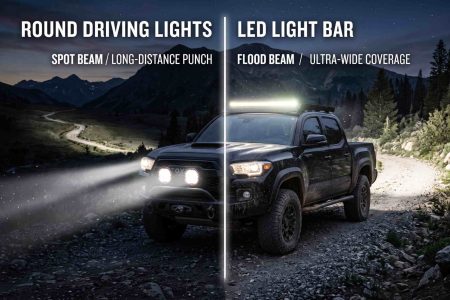
Every lamp makes a choice between reach and coverage, and the choice is visible in the shape of the beam rather than in its total flux. A narrow hotspot concentrates intensity and buys distance at the price of a small lit zone; a wide flood spreads the same flux thinner and buys coverage at the price of reach. A combo bar does neither particularly well and both acceptably, which is why it is the common default.
For a driver, the practical question is which zone the hotspot covers at the distance where hazards appear. A hotspot 8 m wide at 100 m covers roughly one lane. A hotspot 3 m wide at 150 m covers a motorcycle. Both can be excellent lamps; they are answering different questions, and the spot versus flood selection guide exists precisely because the right answer depends on the job rather than on the number.
What you should not accept is a distance figure with no width attached. “1 lux at 300 m” delivered through a 4° pencil is a searchlight result, not a driving result, and a lamp sold for trail use on that basis will disappoint the first time the trail bends.
Catalogue structure follows the same split. The LED light bars category collects the long housings that combine several optics side by side, the light pods category collects the compact units built around a single optic, and a bar such as the Pinnacle Series 40 inch curved spot beam sits at the spot end of that range by name. None of those descriptions carries a candela figure, which is exactly the gap this guide is about: a product name tells you the shape of a beam, and only a photometric number tells you how far it reaches.
Two lamps do not double the distance
Because intensity adds where beams overlap and distance scales with the square root of intensity, two identical lamps aimed at the same point extend the threshold distance by a factor of 1.41, not 2. Four lamps double it.
| Identical lamps, beams overlapping on axis | Relative intensity | Distance at the same lux threshold |
|---|---|---|
| 1 | 1.00× | 1.00× |
| 2 | 2.00× | 1.41× |
| 3 | 3.00× | 1.73× |
| 4 | 4.00× | 2.00× |
| 6 | 6.00× | 2.45× |
| 8 | 8.00× | 2.83× |
The qualifier matters as much as the table. If two lamps are mounted a meter apart and aimed straight ahead rather than converged, their beams overlap only partially, so the on-axis gain is smaller than 2× and the coverage gain is larger. That is usually the better arrangement for trail driving, because what a driver needs is a lit corridor rather than a brighter dot, but it means the distance table does not apply directly.
Two lamps also double the current draw and the heat, so the electrical and thermal consequences scale linearly while the distance benefit scales as a square root. That is a poor exchange rate, and it is the reason a single better-aimed lamp usually beats two cheap ones.
What each job needs: distance, illuminance and candela by use
The following ranges are engineering estimates for planning, not measurements and not manufacturer figures. They assume a dark environment, a clean lens, and a driver or worker with normal night vision. Use them to pick a candela class, then verify with the lamp’s own data.
| Job | Useful distance | Illuminance target | Implied peak intensity | Beam note |
|---|---|---|---|---|
| Hitching a trailer, reversing | 5 to 10 m | 5 to 20 lux | 125 to 2,000 cd | wide flood, mounted low |
| Roadside repair, engine bay, cargo | 3 to 8 m | 20 to 50 lux | 180 to 3,200 cd | flood, shadow-free |
| Camp site, awning, cooking area | 10 to 20 m | 1 to 5 lux | 100 to 2,000 cd | flood or combo |
| Walking-pace trail, rock crawling | 30 to 60 m | 1 to 2 lux | 900 to 7,200 cd | combo, hotspot about one lane |
| Forest track at 30 to 50 km/h | 60 to 120 m | 1 to 2 lux | 3,600 to 28,800 cd | spot or combo |
| Open desert, high-speed auxiliary | 200 m and beyond | 1 to 5 lux | 40,000 to 200,000 cd | narrow spot, aimed long |
Two patterns in that table are worth naming. Close-range work is an illuminance problem, not a distance problem: a wide work light of modest intensity easily produces 20 to 50 lux at 5 m, because the square law is working in your favor at short range, which is why the close-range rows belong to the LED work lights category rather than to a long bar. Long-range driving is an intensity problem, because the square law takes away four times the illuminance every time you double the distance, and no amount of beam width fixes that.
The middle rows are where most buyers actually live, and they are also where the market’s numbers are least useful. A trail lamp needs 1 to 2 lux at 60 to 120 m, which is 3,600 to 28,800 cd — a range of eight to one that a single “20,000 lumens” figure cannot distinguish.

Mounting height and aim change the number on the ground
The square law assumes the light arrives perpendicular to the surface. On the ground it rarely does, and the shortfall is the cosine of the angle between the beam and the surface normal — which produces a third power of distance rather than a second. For a lamp at height h aiming at a point at ground distance x, E = I·h/(x² + h²)^{3/2}.
| Ground distance from directly below | Slant angle from vertical | Incidence factor | Illuminance as a fraction of the nadir value | Extra loss versus the square law alone |
|---|---|---|---|---|
| 0 | 0° | 1.000 | 100% | none |
| 0.5 h | 26.6° | 0.894 | 72% | 11% |
| 1.0 h | 45.0° | 0.707 | 35% | 29% |
| 2.0 h | 63.4° | 0.447 | 8.9% | 55% |
| 3.0 h | 71.6° | 0.316 | 3.2% | 68% |
The practical reading is counter-intuitive and useful. At long range the slant penalty almost vanishes: a light bar 2 m above the ground aimed at a point 100 m away meets the ground at about 1.1° from horizontal, and the incidence factor is 0.9998. At close range the same bar aimed at a point 4 m away meets the ground at 26.6° and loses 11 percent before any other loss. That is why high-mounted bars are good at throwing light down a track and poor at lighting the ground at your feet, and why the site’s guide to mounting positions treats height as a trade rather than a free upgrade.
Aim matters more than height. Moving a beam’s axis by one degree changes the ground hit point by 1.7 m at 100 m, which is enough to take the hotspot off the road and put it in the trees — or into an oncoming driver’s windscreen. The aiming procedure and the glare consequences are set out in the site’s aiming and glare guide; what matters here is that the candela figure you bought is only delivered to the road if the axis is where you think it is.
How to measure a lamp you already own
You do not need a laboratory to check a claim. A lux meter with a calibration certificate costs less than a mid-range light bar, and an uncalibrated one is still useful for comparing two lamps on the same night. The procedure below produces a candela figure accurate enough to compare with any published number.
| Step | Action | Reason |
|---|---|---|
| 1 | Find a dark, flat, open area with no street lighting | ambient light adds directly to the reading |
| 2 | Measure from the lens face, not from the bumper | the square law uses the distance to the source |
| 3 | Take the on-axis reading at 10 m | far enough for the point-source assumption, close enough for a modest meter |
| 4 | Record lux and the exact distance | candela equals lux multiplied by distance squared |
| 5 | Repeat at 20 m if space allows | confirms the square law and exposes aim error |
| 6 | Repeat after 20 minutes of running | steady-state output, not the cold first minute |
| 7 | Note the meter’s orientation | a tilted meter reads low because of cosine error |
A reading of 500 lux at 10 m is 50,000 cd, which is 1 lux at 224 m, or 0.25 lux at 447 m. A reading of 100 lux at 10 m is 10,000 cd, which is 1 lux at 100 m. Those two lamps differ by a factor of 2.24 in distance, and no catalogue would make that clear.
For scale on what “accurate” means: NIST’s realization of the candela currently carries an uncertainty of 0.2 percent at k = 2 (NIST, Realization of the candela). A hobby meter will be nowhere near that, and a phone application is further away again, because it reads a sensor behind an unspecified diffuser or estimates from a camera image with no traceable calibration. Use a phone app to compare two lamps in the same session and for nothing else; do not use it to validate a claim against a specification.
Reading a specification sheet: six lines that decide the distance
Most listings contain the information needed to compute reach, just not in a form that makes it obvious. These are the six lines worth finding, and what a sheet that respects the buyer does with each.
| Line on the sheet | Why it decides distance | What a serious sheet says |
|---|---|---|
| Peak intensity in candela | the only direct input to the distance calculation | the measurement distance and the instrument used |
| Beam angle | converts flux into intensity | whether it is the full angle at 50 percent of peak |
| Lumen figure | tells you total flux, never reach | whether it is a luminaire measurement or a bin sum |
| Voltage and current | derating and wiring consequences | a range such as 9 to 32 V, not a single nominal |
| Thermal note | steady-state versus cold output | the ambient temperature at which ratings apply |
| Ingress and vibration ratings | survival, not reach | the standard and the test condition |
If peak intensity is missing, the next best thing is a stated illuminance at a stated distance, because that converts to candela in one multiplication. A sheet that says “1,200 lux at 10 m” is telling you 120,000 cd, whether or not it says so. A sheet that says only “24,000 lumens” is telling you nothing about distance, and a sheet that says only “1,000 m” is telling you a threshold-free number that cannot be checked.
The light bar beam distance question therefore resolves into a documentation question. Ask for the candela figure and the angle; if both arrive, the arithmetic in this guide finishes the job in under a minute.
Questions to ask a supplier before you order
- What is the peak intensity in candela, and at what distance was it measured?
- Is the beam angle the full angle at 50 percent of peak, or at 10 percent?
- Is the lumen figure a measurement of the finished lamp or a sum of LED bin ratings?
- At what ambient temperature and after how long of running were those numbers taken?
- Does the lamp hold its output at 13.5 V, or does the driver fold back as it heats?
- What current does it draw at 13.5 V, and what fuse does the manufacturer specify?
- Can you send the photometric report, or at least the illuminance at 10 m on axis?
- What is the warranty position on water ingress and on LED failure, in writing?
A supplier who can answer the first three questions is selling a lamp you can evaluate. A supplier who cannot answer any of them is selling a lumen number and a photograph, and the photograph was almost certainly taken with a long exposure that flatters the beam.
Where the numbers stop: limits of the calculation
The arithmetic in this guide is exact for a point source in clean air, and every departure from that description introduces error you should know about.
The point-source assumption fails close in. At 2 m from a 1 m wide bar, different parts of the bar are at different distances and the illumination is nothing like a 1/d² pattern; measurements at 10 m are already much better behaved. Multi-emitter lamps with wide spacing behave like an array rather than a point until several meters out.
Atmospheric scattering is not in any of the equations. Fog, snow, dust and heavy rain both attenuate the beam and send light back toward the driver, which reduces the useful distance far more than the square law predicts and increases glare at the same time. A lamp chosen for 1 lux at 150 m on a clear night will not deliver 150 m of usable visibility in fog, and no candela figure changes that.
Lens condition and aging also drop out of the calculation. A dirty lens can lose a meaningful fraction of the flux, and LED output declines over life; the site’s guide to lumen maintenance explains how L70 ratings describe that decline. A lamp rated at 1 lux at 200 m when new is not rated at 1 lux at 200 m at end of life.
Human factors are the largest omission. Illuminance on a flat plane is not the same as the ability to recognize a hazard, which depends on contrast, color, adaptation, glare from the lamp’s own spill, and the driver’s age. That is why a photometric report and a test drive answer different questions, and why neither one alone settles a purchase.
The legal boundary: auxiliary lights are not headlamps
Nothing in this guide makes a lamp legal to use on a public road. The calculations tell you what a lamp will illuminate; they say nothing about whether you may run it in traffic, and those rules are set by federal vehicle standards for the lamps fitted to a new vehicle and by state or national traffic law for how you may use auxiliary lighting. The site’s guide to whether LED light bars are street legal covers that boundary and the variation between jurisdictions, and we are deliberately not repeating or extending its conclusions here.
What the numbers do establish is a safety argument that runs in the same direction as the law. A lamp that produces 50,000 cd on axis will produce disabling glare for an oncoming driver at a considerable distance, and the further it throws, the further away that problem starts. Reach is not free; it is paid for in glare management, which is why aiming discipline and a switch you can reach without looking matter as much as the candela figure.
For off-highway use the same physics applies to your own eyes. A very bright near-field spill destroys the dark adaptation that the far field depends on, so a lamp with a modest hotspot and controlled spill often shows more of the trail than a brighter lamp with a wide bright foreground.
A five-step buying sequence for distance
- Decide the distance and the illuminance: for trail work, 1 to 2 lux at 60 to 120 m; for open-country auxiliary use, 1 lux at 200 m or more.
- Multiply to get the candela you need: 1 lux at 100 m is 10,000 cd; 2 lux at 100 m is 20,000 cd; 1 lux at 200 m is 40,000 cd.
- Choose the beam angle that puts the hotspot where hazards appear, then check that the lamp’s flux is plausible for that angle using the cone table above.
- Compare only lamps that publish candela, or convert stated illuminance at a stated distance into candela before comparing.
- Plan the mounting, the aim and the switch, then verify the installed result with a meter at 10 m rather than trusting the box.
That sequence takes about twenty minutes and replaces most of the guesswork in a purchase. It also gives you a written specification you can send to a supplier, which is the fastest way to find out whether the supplier has data or adjectives.
Frequently asked questions
How many lumens do I need to see 100 meters?
There is no single number, because the answer depends on beam width. To hold 1 lux at 100 m you need about 240 lm inside a 10° cone, about 977 lm inside a 20° cone, about 4,162 lm inside a 40° cone and about 31,416 lm inside a 90° cone, assuming the flux is spread uniformly and nothing is lost. A real lamp needs more than these figures because optics, lenses and thermal derating all take a share.
Is candela more important than lumens for distance?
Yes. Distance is set by intensity in candela, which is flux per unit solid angle, so a narrow beam converts a modest flux into a high intensity. Lumens tell you how much light the lamp produces in total; candela tells you how much of it is aimed where you are looking. For a distance decision, candela is the only one of the two that enters the equation directly.
What does 1 lux actually look like?
About as much light as a full moon on a cloudless night puts on the ground, according to the comparison in the IIHS headlight evaluation. It is enough to see shape and contrast at close range in an otherwise dark environment, and it is far below the 5 lux that IIHS uses as its headlamp criterion. A lamp claiming 1 lux at 300 m is claiming moonlight at 300 m.
Why do two lights with the same lumens reach different distances?
Because beam angle decides how the flux is concentrated. Halving the full beam angle roughly halves the illuminated area at a given distance, so the same flux produces roughly four times the intensity and about twice the distance at a fixed threshold. Optical design, LED placement and lens choice all change the angle, which is why two bars with identical lumen figures can differ by a factor of three in reach.
Does a 1,000-meter rating mean I can see 1,000 meters?
It means the beam holds whatever threshold the seller used at 1,000 m, usually 0.25 lux on axis. At 1,000 m, 0.25 lux implies about 250,000 cd. Whether a driver can see anything useful at that distance depends on the size and contrast of the object, the atmospheric conditions, and the glare the lamp produces closer in. Treat the figure as a threshold statement, not a visibility promise.
Do two light bars double the distance?
No. Where beams overlap, intensity adds, so two identical lamps extend the threshold distance by the square root of two, about 1.41 times. Four lamps double it. Two lamps mounted apart and aimed slightly outward cover more ground but add less on axis, and they double the current draw and heat, which is a poor trade for a 1.41 times distance gain.
Can I trust a phone light-meter app to check a light bar?
Use it for relative comparisons only. A phone reads an ambient sensor behind an unspecified diffuser or estimates from a camera image, with no calibration traceable to a photometric standard, whereas NIST’s own candela realization carries a 0.2 percent uncertainty at k = 2. A phone can tell you that lamp A is brighter than lamp B on the same night; it cannot tell you that lamp A produces 30,000 cd.
What is the difference between beam distance and beam width?
A light bar beam distance figure is a statement about one point on the axis, at one threshold. Beam width describes how far the light spreads to either side, usually quoted as the full angle at 50 percent of peak intensity. A lamp can have a long beam distance and a narrow beam width, which is excellent for a searchlight and poor for a trail where the corners matter. Buy both numbers or buy neither.
Editorial note
Written and checked by the SAEC Lighting Engineering Team, Foshan. This article derives its conversions from the definitions published by the International Commission on Illumination and the U.S. National Institute of Standards and Technology, and uses the Insurance Institute for Highway Safety’s published headlight test criteria as its reference for the 5 lux and 1 lux comparisons. Every figure labeled as a calculation was computed from those definitions; every range labeled as an estimate is an engineering planning range, not a measurement of any product.
Last updated: 2026-10-18
Sources
- CIE, e-ILV term 17-21-084, lumen — https://cie.co.at/eilvterm/17-21-084
- CIE, e-ILV term 17-21-045, luminous intensity — https://cie.co.at/eilvterm/17-21-045
- CIE, e-ILV term 17-21-085, lux — https://cie.co.at/eilvterm/17-21-085
- NIST, SI Units – Luminous Intensity — https://www.nist.gov/pml/owm/si-units-luminous-intensity
- NIST, Realization of the candela — https://www.nist.gov/pml/sensor-science/optical-radiation/realization-candela
- NIST, Realization of related photometric units — https://www.nist.gov/pml/sensor-science/optical-radiation/realization-related-photometric-units
- IIHS, Headlights (about our tests) — https://www.iihs.org/ratings/about-our-tests/headlights
- SAEC, Raw Lumens vs Effective Lumens — https://saec-lights.com/lighting-basics/raw-lumens-vs-effective-lumens-the-truth-behind-led-brightness-ratings/
- SAEC, Reflector Cup vs TIR Lens — https://saec-lights.com/lighting-basics/reflector-vs-tir-lens-led-beam-pattern/
- SAEC, LED Light Bar Thermal Management — https://saec-lights.com/lighting-basics/led-light-bar-thermal-management-explained/
- SAEC, LED Lumen Maintenance: LM-80 and TM-21 — https://saec-lights.com/lighting-basics/led-lumen-maintenance-lm80-tm21-l70/
- SAEC, Spot vs. Flood LED Work Lights — https://saec-lights.com/buying-guides/spot-vs-flood-led-work-lights/
- SAEC, LED Light Bar Mounting Positions — https://saec-lights.com/buying-guides/led-light-bar-mounting-positions-roof-grille-bumper/
- SAEC, Auxiliary Light Aiming and Glare — https://saec-lights.com/standards-safety/auxiliary-light-aiming-glare-safety-guide/
- SAEC, Are LED Light Bars Street Legal — https://saec-lights.com/standards-safety/are-led-light-bars-street-legal/
 by


