


On this page
A warning beacon is not bought by brightness or brand; it is bought by the standard it was tested against, the class that standard assigns it, the flash rate the local rule allows, and the mounting position the vehicle actually gives you. That single sentence is the whole buying decision, and it is the reason this guide exists. Search the market for “amber LED warning light” and you will find the same lens, the same 30 W or 68 W power figure and the same IP67 claim stamped on housings that are certified for completely different jobs. Some are approved as omnidirectional warning devices with 360° horizontal coverage. Some are directional flash devices with a 20° horizontal cone. Some are sold into markets where a warning beacon is a legal light, and some into markets where it is only a courtesy light. The certificate decides which of those you are buying, and the class decides where on the vehicle the light is allowed to sit.
This guide is written for the people who actually place the purchase order: commercial vehicle owners, fleet managers, upfitters and dealers specifying beacons and light bars for service trucks, tow trucks, refuse and recycling vehicles, forklifts, municipal trucks and snow ploughs. It walks through the two certification systems you will see on almost every listing (ECE R65 in Europe and much of the rest of the world, SAE J845 and J595 in North America), the class ratings attached to them, the flash rates that regulators and standards bodies actually name, the colour rules that trip up more buyers than any optical specification, the mounting height and zoning discipline that turns a set of lights into a system, the electrical budget, the durability claims, and the certificate verification steps that separate a real approval from a decorative logo.
One editorial rule runs through every section: where a number or a class definition could not be verified against the regulating text itself, this guide says so in the sentence that uses it. You will find more explicit uncertainty statements here than in a typical buying guide, and that is deliberate. In this product category the honest answer to “which class is better” is to check the specification your market or your customer requires, then ask the supplier for the certificate for that exact model — not to accept a ranking.
Quick answer
Anyone asking how to choose LED warning beacon R65 vs SAE J845 class 1 vs class 2 equipment should know the short version first: buy a warning beacon by certifying it against the standard your market enforces, then match the class to the vehicle’s job, then verify the flash rate and mounting height against the local rule, and only then compare brands. Concretely:
- In Europe and in most export markets, the relevant beacon standard is ECE R65, which governs a beacon’s photometric values, light distribution and the position of its colours. One beacon manufacturer states plainly that only beacons meeting ECE R65 may be used on public roads; treat that as the manufacturer’s statement of the market requirement rather than as a quotation of the regulation text, because the R65 document itself could not be retrieved for this guide.
- In North America, SAE J845 covers omnidirectional warning devices (360° of light output horizontally, from 5° above to 5° below horizontal) and SAE J595 covers directional flashing warning devices (20° left and right, 10° up and down). Those geometry figures come from a manufacturer technical page and are widely repeated as the common industry interpretation; the official SAE scope text was not obtainable for this guide, so no minimum intensity values for either standard are quoted here.
- The SAE Class I, Class II and Class III labels are use-based categories, not brightness tiers: Class I for emergency vehicles (fire, police, ambulance, rescue), Class II for authorised maintenance and service vehicles (utility, tow, road construction), Class III for vehicles where the light is for identification only, such as forklifts and yard equipment.
- Flash rate is regulated in some markets and merely conventional in others. UK lighting regulations cap a single warning beacon between 60 and 240 flashes per minute with evenly spaced intervals, and require the lamp’s centre to sit at least 1,200 mm above the ground. Minnesota limits 360° strobe lights on refuse vehicles to 60–120 flashes per minute. A fire-apparatus buyer’s guide translating NFPA 1901 asks for a minimum of 75 flashes per minute per light source and 150 flashes per minute from every point that can see the vehicle.
- Amber is the work colour. Blue is the emergency colour, and on both sides of the Atlantic it is restricted: UK regulations prohibit blue warning beacons on non-emergency vehicles outright, and Minnesota reserves blue principally for government road maintenance and snow-removal equipment.
- Mounting height and zoning beat raw output. Height bands of 18–62 in for the lower zone on vehicles 25 ft and longer (18–48 in on shorter vehicles), upper optical centres no higher than 8 ft on short vehicles, and no gap greater than 25 ft between lower lights are the working rules in the NFPA 1901 material summarised by FAMA in 2018 — a secondary digest, not the current paid standard.
- Electrical budget matters more than most buyers expect: the same fire-apparatus digest caps the average current draw of a minimal warning system at 40 A in blocking mode on large vehicles, with 5 A extra per mid-body group, and 35 A on vehicles shorter than 25 ft.
The rest of this guide expands each of those points into something you can put in a purchase specification, and flags exactly where the evidence stops.
The two certification systems you are actually choosing between
A warning beacon bought for a commercial vehicle is normally certified under one of two unrelated regimes, and the regimes do not test the same things. ECE R65 is a European regulation published through the UNECE framework that deals with a beacon’s photometric performance, its light distribution and where its colours may sit. SAE J845 and SAE J595 are North American SAE recommended practices, one for omnidirectional warning devices and one for directional flashing warning devices. A manufacturer technical page confirms that the two systems specify different content and use different test methods, and notes that suppliers exporting into both markets commonly hold both approvals. That is the practical reason most industrial LED beacons on the market carry two marks instead of one: not marketing enthusiasm, but two separate customer bases.
| Attribute | ECE R65 (Europe and export markets) | SAE J845 (omnidirectional) | SAE J595 (directional flash) |
|---|---|---|---|
| What it governs | Beacon photometric values, light distribution, colour position | Omnidirectional optical warning device performance | Directional flashing optical warning device performance |
| Horizontal coverage | Not stated in R65 text obtainable for this guide | 360° of arc | 20° left and 20° right |
| Vertical coverage | Not stated in R65 text obtainable for this guide | 5° above to 5° below horizontal | 10° above to 10° below horizontal |
| Class structure | Class designations used with R65 approvals; the thresholds behind them were not verified | Class I, II, III as use categories | Class I, II, III as use categories |
| Evidence grade in this guide | Manufacturer statement plus two secondary industry articles, partly contradictory | Manufacturer technical page (industry interpretation) | Manufacturer technical page (industry interpretation) |
Read the table as a map of what each approval is for, not as a performance ranking. Nothing in the table says a J845 device is brighter than an R65 device or the reverse. The two documents answer different questions: R65 asks whether a beacon performs photometrically the way a European regulator expects a beacon to perform; J845 asks whether a light behaves as an omnidirectional warning device in the North American sense.
There is a persistent misunderstanding worth killing early. The phrase “R65 certified” on a listing tells you a document exists somewhere that names a model and a class. It does not tell you which model, which class, or whether the certificate is still valid. The section on certificate verification, later in this guide, gives you the four-step check that resolves that question in about ten minutes of email.
ECE R65 in practice: what the regulation controls
ECE R65 regulates three things for a beacon: the photometric values it must reach, the distribution of its light, and the position of its colours. If you strip away the marketing, that is the entire scope. One beacon manufacturer’s technical brochure states that only beacons meeting ECE R65 may be used on public roads, which is the clearest short statement of why the mark matters commercially.
The trouble is that the regulation text itself was not retrievable while preparing this guide. The UNECE publication is served behind a protection layer that returned an access error, and the UN digital library returned an empty response. Two secondary industry articles were read instead, and they disagree on the point buyers ask about most.
| Claim about R65 classes | Source type | What this guide does with it |
|---|---|---|
| Class 1 minimum 50 cd, Class 2 minimum 100 cd, with Class 2 intended for night road use | Secondary industry article, April 2026 | Reported as that source’s own reading, not as regulation text |
| Class 1 has the lower threshold and is used on general commercial and engineering vehicles; Class 2 has the higher threshold and is used on emergency vehicles | Secondary industry article, August 2026 | Reported as that source’s reading, not as regulation text |
| Flash frequency 2–5 Hz, i.e. 120–300 flashes per minute | Secondary industry article, April 2026 | Marked as unverified against R65 text |
| Flash frequency “roughly 1–4 Hz depending on market and application” | Secondary industry article, August 2026 | Marked as unverified against R65 text |
Two articles, two different candela tables, two different frequency ranges, and — importantly — opposite statements about which class sits higher. One treats Class 1 as the 50 cd entry level and Class 2 as the 100 cd tier for road use at night. The other describes Class 1 as the lower bar for general commercial vehicles and Class 2 as the higher bar for emergency vehicles. Those two readings happen to point the same way on the question of which is stricter, but they attach the classes to different vehicle populations, and neither article publishes a test report number that would let you settle it.
So the correct buying behaviour is not to memorise a candela number. It is to find out which class your market, your customer or your tender document specifies, buy a beacon whose certificate names that class, and archive the certificate with the vehicle file. If you are specing for road work and low-visibility conditions, the practical instruction that survives the contradiction is: prefer a model whose documentation explicitly claims the higher class in your market’s terms, and ask the supplier to produce the certificate for that exact model before you order volume.
R65 approvals also carry a marking physically on the product. The approval mark format described in industry sources is an E in a circle, a country code, the regulation number, and an approval number, with the class shown either as a T or X designation or as 1 or 2 depending on how the approval was written. A beacon with no approval number, or with a mark that omits the number entirely, is a beacon whose approval cannot be checked — which in a compliance context is the same as having none. This guide does not reproduce a specific approval number from any real certificate, for the simple reason that the R65 document that would let a reader decode it was not obtainable.
Where R65 sits relative to UK law
The relationship between ECE R65 and UK lighting law is one of the genuinely unresolved points in this subject, and it is worth stating plainly rather than smoothing over. One secondary source claims that UK roadside enforcement treats a warning beacon without an R65 mark as non-compliant. The UK Road Vehicles Lighting Regulations 1989 tell a different story at the specific point where they deal with warning beacons: Schedule 16, which sets out the requirements for warning lamps, lists “Markings” with the value “No requirement”. The same schedule also records “no requirement” for lighting area, power, intensity, electrical connections and the indicator.
Both statements can be true at once if the R65 obligation arises somewhere other than Schedule 16 — for instance through vehicle type approval or through an operator’s own procurement conditions — but that link was not verified here. The practical takeaway for a UK or UK-supplying buyer is to treat R65 as a commercial expectation that may or may not have a direct hook in the lighting schedule, and to rely on the requirements you can actually read: the height, the colour list and the flash-rate band in Schedule 16.
SAE J845 and J595: geometry, not brightness
The North American system splits warning optics into two physical shapes, and the shapes have numbers attached.
SAE J845 describes an omnidirectional warning device: light output spread across 360° in the horizontal plane, and vertically from 5° above horizontal to 5° below. A classic single beacon on a roof post is the archetype. SAE J595 describes a directional flashing warning device: a signal that covers 20° to the left and 20° to the right horizontally, and 10° up and 10° down vertically. A grill or surface-mount strobe aimed along an axis is the archetype.
Those four angle pairs are the most useful numbers in the whole North American warning-light conversation, because they predict field behaviour. A 360° device at roof height will be seen from any direction around the vehicle, at the cost of putting a fraction of its total output into any one viewing direction. A 20° device concentrates what it has into a cone, so a pair aimed fore and aft covers two corridors well and the flanks not at all.

The official scope text for these standards was not available: the SAE standards pages are rendered by client-side script and returned only a page header, and the ANSI webstore returned an access error. Everything in this section and the next therefore rests on a manufacturer’s technical explanation of the two standards, which is a reasonable industry summary but not the standards themselves. No minimum intensity figure for either J845 or J595 is stated anywhere in this guide, because no such figure was verified.
The SAE Class I, II and III labels are use categories
The most consequential thing to get right about the SAE classes is that they describe what the vehicle is, not how many candela the lamp produces. As explained on the same manufacturer technical page:
- Class I applies to emergency vehicles: fire apparatus, police, ambulance and rescue.
- Class II applies to authorised maintenance and service vehicles: utility trucks, tow and recovery vehicles, road construction equipment.
- Class III applies to vehicles where the warning device is used for identification only, such as forklifts and yard machinery.
That mapping has immediate procurement consequences. If you specify “Class I” for a refuse truck because you assume higher class means brighter, you may be specifying a device whose approval was written for a population your vehicle is not in, and you may be paying for an approval you cannot use. If a tender document demands Class II for a tow truck, that is consistent with the definition above. If a municipal specification asks for Class III on a road-legal truck, the specification is probably wrong.
Cross-check this against how a state actually writes its law. Minnesota requires that a garbage or recycling truck using an amber warning light carry a light meeting “the SAE standard for authorized maintenance and service vehicles, Class 2” — the class label is used as a vehicle-category qualification in the statute itself. That is a rare case where the use-based reading of the classes is visible in primary law rather than inferred from a vendor page. It also shows how a state can borrow a standard’s vocabulary without adopting the standard’s internal numeric thresholds.
The J845 and J595 minimum intensity tables were not verified, and this guide does not guess at them. If you need to compare two J845 lamps on intensity, the only defensible route is to request the test report or the certificate that names each model and compare what the accredited laboratory actually measured.
Class 1 vs Class 2 — and why the industry cannot agree
This is the section most buyers arrive for, and the honest version is uncomfortable: the relationship between Class 1 and Class 2 is described differently by different sources, in different standards, and in different markets. There are at least three separate class vocabularies in play — the European R65 classes, the SAE Class I/II/III categories, and whatever class language a national or state rule borrows — and they are not interchangeable.
Start with the European pair. Two industry articles read side by side give you:
| Reading | Class 1 | Class 2 | Source character |
|---|---|---|---|
| Candela-led reading | 50 cd minimum, described as a lower threshold | 100 cd minimum, described as suited to road use at night | Secondary industry article, April 2026 update |
| Application-led reading | Lower threshold, general commercial and engineering vehicles | Higher threshold, emergency vehicles | Secondary industry article, August 2026 |
The two readings agree that Class 2 is the more demanding of the two in Europe, but they attach different vehicle populations and different numbers to it, and the R65 text that would settle the matter was not retrievable. Because of that, this guide does not present a class ranking as fact, and specifically does not tell you that Class 2 is always the right purchase.
Now the North American pair, which is a different animal entirely. The SAE Class I / II / III labels are use categories: emergency vehicles, authorised service vehicles, identification-only vehicles. They are not an ordered brightness scale. A listing that says “SAE Class 1, brighter than Class 2” is mixing the North American category vocabulary with a claim those categories do not make.
Then there is the borrowed vocabulary in state law. Minnesota’s rule for refuse and recycling vehicles requires a light meeting the Class 2 level of the SAE standard for authorised maintenance and service vehicles, and separately requires that a 360° strobe light on such a vehicle reach “SAE J845 Class 2” light output while being a double-flash type, certified waterproof by its manufacturer, and flashing 60 to 120 times a minute. Whatever “J845 Class 2” means in test terms, the state has made it a legal condition for operating one specific type of vehicle with one amber lamp.
So the practical answer to how to choose LED warning beacon R65 vs SAE J845 class 1 vs class 2 is a sequence, not a ranking:
- Identify which standard your market or contract actually enforces — R65, J845, J595, or a national rule that borrows one of their class labels.
- Read the class requirement in that document, in that document’s own vocabulary, without translating it into another system’s class names.
- Ask the supplier for the certificate and test documentation covering the exact model number, not the product family.
- If the document leaves the class ambiguous — and tender documents frequently do — specify the higher-performing option that the supplier can document, and put the documentation requirement into the purchase order.
- Record the certificate with the vehicle. When enforcement or an insurer asks, the paper is the product.
The one thing you can safely conclude from the contradictory sources is that neither class label is self-explanatory. Treat every class claim as a pointer to a document you have not yet read.
Flash rate and flash patterns: the numbers that are actually written down
Flash rate is the specification buyers quote most often and understand least. It is expressed in three different units depending on who is talking — flashes per minute (FPM), hertz, or “patterns” — and only some of those numbers come from regulators.
| Requirement | Number | Jurisdiction or document | Evidence grade |
|---|---|---|---|
| Single warning lamp flash frequency | Not less than 60 and not more than 240 per minute, at even intervals | UK Road Vehicles Lighting Regulations 1989, Schedule 16 | Primary regulation text |
| 360° strobe light on refuse and recycling vehicles | 60 to 120 per minute, double-flash type | Minnesota Statutes 169.64 | Primary statute text |
| Minimum per light source | 75 per minute | NFPA 1901 as summarised by FAMA in 2018 | Secondary digest of a paid standard |
| Minimum from any one observation point | 150 per minute | NFPA 1901 as summarised by FAMA in 2018 | Secondary digest of a paid standard |
| R65 flash frequency | Reported as 120 to 300 per minute (2–5 Hz) by one source, and as roughly 1–4 Hz by another | Two secondary industry articles | Unverified against R65 text |
| Practical product pattern steps | 75 FPM, 125 FPM single, double and quad flash, 600 FPM strobe | SAEC product pages, first-party manufacturer claims | Manufacturer self-description |
Two things stand out when the table is laid out this way. First, the UK band and the Minnesota band overlap: 60 to 120 flashes per minute satisfies both. That overlap is the safest single number to carry into a specification if you operate in multiple jurisdictions and cannot verify each one. Second, the maximum matters as much as the minimum. A 600 FPM strobe pattern is a legal choice in jurisdictions that set no ceiling, and a violation in the UK if the lamp is a warning beacon regulated by Schedule 16, because 600 exceeds 240.
Take the UK requirement seriously as a design constraint, not a formality. “Not less than 60 and not more than 240 flashes per minute, at even intervals” rules out not only very fast strobes but also irregular or burst patterns on a lamp that falls under the schedule. If your LED beacon offers a “random” or “aggressive” pattern and you operate in the UK, check whether the pattern is compliant before you enable it.
The 75 FPM and 150 FPM figures from the NFPA 1901 material deserve their own note on scope. They come from a fire apparatus manufacturer association’s 2018 buyer’s guide summarising the standard, and they were not checked against the current edition of NFPA 1901, which is a paid document that was not obtained for this guide. They are useful as engineering guidance for any fleet — a single lamp under 75 flashes per minute reads as a marker light rather than a warning device, and a vehicle whose visible flash rate from any one viewing point falls below 150 per minute is unlikely to be noticed at speed. But do not cite chapter and verse from them, and verify the current edition before you write them into a purchasing specification that references NFPA.
Synchronisation: what it does and what it does not do
Multi-lamp synchronisation is a feature listed on essentially every industrial LED beacon, and it is worth understanding what it buys you. When two or more lamps are synchronised, they flash in a coordinated sequence rather than drifting in and out of phase. The NFPA-derived material contains a requirement of the same family: the failure of any single lamp must not leave an area of the vehicle without a light source. Synchronisation does not satisfy that requirement, but it does make the alternation between lamps predictable, which is what lets a two-lamp or four-lamp installation be planned as a system rather than as a collection of parts.
The practical synchronisation questions to ask a supplier are: how many lamps can be linked on one control line, what cable and connector scheme does the link use, can the link survive a lamp failure without taking down the others, and does the pattern memory persist across power cycles. The station’s industrial warning lights list pattern memory and multi-lamp synchronisation among their features, which means the answer to the last question at least is a documented feature rather than a claim.
Colour is a legal question before it is an aesthetic one
The colour of a warning beacon is the specification most likely to put an operator on the wrong side of a rule, because colour rules are written in national and state law and they differ. Amber is the general-purpose work colour. Blue is the emergency colour. Red is reserved in most jurisdictions for the front of a vehicle and for emergency use. None of that is optional styling.
The cleanest way to see the shape of the problem is to compare two US states and one national regime on the same page.
| Jurisdiction | Rule that matters to a beacon buyer | Source |
|---|---|---|
| Minnesota | Service vehicles may carry an amber flashing light approved by the commissioner of public safety, but it may be lit only at the scene of a disabled vehicle, or for snow removal, or for road maintenance. Self-propelled farm implements may use one at any time. Blue lights are in principle limited to government road maintenance and snow-removal equipment. Refuse and recycling vehicles may use a single amber warning light meeting the SAE authorised maintenance and service vehicles Class 2 standard, only while collecting, meaning stopped or travelling between collection points at least 10 mph below the posted limit | Minnesota Statutes 169.64 |
| Wisconsin | On a highway, only white or amber is allowed at the front of a vehicle and only red at the rear, and flashing lights are prohibited except as the chapter authorises. Lamps at the front with an intensity above 300 candlepower — including adverse-weather lamps, spot lamps and auxiliary lamps — may not be lit more than four at a time | Wisconsin Statutes 347.07 |
| United Kingdom | No vehicle other than an emergency vehicle may be fitted with a blue warning beacon, a “special warning lamp” (defined in that regulation as a lamp capable of emitting only a blue flashing light), or anything resembling one, including when it is not working | Road Vehicles Lighting Regulations 1989, Regulation 16 |
| United Kingdom | Warning lamps must be blue, amber, green or yellow as provided by Regulation 11, and a single lamp must flash not less than 60 and not more than 240 times a minute at even intervals, with the centre of the lamp at least 1,200 mm above the ground | Road Vehicles Lighting Regulations 1989, Schedule 16 |
| United States, federal | The statutory emergency equipment list for commercial power units is three bidirectional emergency reflective triangles meeting FMVSS 125, or at least six fusees or three liquid-burning flares; a red flag at least 12 in square; and spare fuses of each rating. Amber warning lights are not part of that federal list | 49 CFR 393.95 |
Read across that table and a pattern appears. Amber is the colour that travels: it is permitted for the work vehicles this guide is about in Minnesota, it is permitted at the front of a vehicle in Wisconsin, and it is one of the four colours Schedule 16 allows in the UK. Blue does not travel: it is restricted to government road maintenance and snow equipment in Minnesota and prohibited outright on non-emergency vehicles in the UK, with the UK prohibition extending to fittings that merely resemble a blue beacon even when they are switched off.
Two further boundary conditions deserve attention because they catch out buyers who focus only on the beacon.
The first is Wisconsin’s candlepower ceiling on forward lamps. A lamp at the front of a vehicle with an intensity above 300 candlepower — the statute names adverse-weather lamps, spot lamps and auxiliary lamps — may not be illuminated more than four at a time. If you are adding a forward-facing strobe or an amber-and-white combination lamp to a vehicle that already runs auxiliary lighting, that count is part of your compliance calculation.
The second is Minnesota’s rule about light striking the road surface. Any lamp other than a headlamp, spot lamp or auxiliary driving lamp with an intensity above 300 candlepower must not throw its beam onto the road surface within 75 ft of the vehicle. For a warning device this is mostly a question of aim and mounting angle: a bright directional flash device mounted low and pitched down can put light on the pavement close to the vehicle and create the exact condition the rule addresses.
None of this generalises. Minnesota and Wisconsin show how two states regulate the same subject differently; they do not describe a national rule for the United States, and neither does any other single source used here. Other states and other countries were not verified. Before you order beacons for a fleet that crosses borders, look up the rules for each jurisdiction you operate in. The division of labour between national equipment standards such as FMVSS 108 and state-level lighting rules is covered in more depth in our LED light bar street legality guide, which is a useful companion read for the front-of-vehicle question even though it addresses auxiliary lighting rather than warning beacons.
One more colour-adjacent point, since glare is the complaint that generates the most pushback from other road users: a warning beacon’s job is to be seen, not to illuminate. Aiming a warning device so that it floods the road ahead of the vehicle is a common installation error and a glare source for oncoming traffic. The principles of aiming and glare control for vehicle lighting are set out in our auxiliary light aiming and glare guide, and they apply to the forward-facing elements of a warning installation.
Mounting height, zones and coverage
A warning system is a coverage problem. The vehicle is a box roughly 25 ft long and 8 ft tall that has to be visible from every direction someone might approach it, and a set of lights is how you close the gaps. The most useful framework for thinking about it comes from the same fire apparatus material referenced earlier: divide the vehicle into four zones and two storeys, and make sure every one of the resulting eight areas has light.
Zone A is the front, Zone C is the rear, and Zones B and D are the two sides. Each of those zones has an upper and a lower level, giving eight areas in total. The design goal is that no area depends on a single lamp, and the failure requirement in the same material says exactly that: a failure must not leave an area without a light source. If you remember nothing else from the zoning framework, remember that the lowest-cost way to satisfy it is often two mid-priced lamps rather than one expensive one.
The height bands that go with the zoning are specific, and they differ between long and short vehicles.
| Vehicle length | Upper level | Lower level | Electrical limit |
|---|---|---|---|
| 25 ft or longer, bumper to bumper | As high as practical and close to the four corners | 18 to 62 in above the ground; if the front and rear lower lights are more than 25 ft apart, add mid-body lights and keep the lower light centres no more than 25 ft apart | Average warning system current not more than 40 A in blocking mode, plus not more than 5 A for each mid-body group |
| Shorter than 25 ft | Optical centre no higher than 8 ft | Close to the front corners, 18 to 48 in above the ground | Not more than 35 A |
These numbers come from the 2018 FAMA digest of NFPA 1901, not from the current edition of the standard, which is a paid document that was not obtained. Treat them as engineering guidance with a documented provenance, and check the current edition before contractually referencing NFPA.
Two operational definitions in the same material matter for how you think about patterns. The first mode is “calling for right of way”, used when the apparatus is responding to an incident. The second is “blocking right of way”, used when the vehicle is parked and working as a barrier — at a crash scene, a work zone or a breakdown. In blocking mode, white light is not permitted. That single sentence has a direct purchasing consequence: if your vehicle works scenes where it acts as a barrier rather than as a responder, a white-and-amber combination lamp needs to be configurable so that the white element can be shut off independently, and the pattern set must include a blocking-appropriate mode.
The blocking-mode current cap of 40 A on larger vehicles and 35 A on vehicles under 25 ft is a warning-system budget, not a battery number, and it shows how much a manufacturer expects a compliant system to draw. It also tells you why LED technology displaced halogen in this application: with LED beacons drawing a fraction of what an equivalent halogen lamp draws, a full zoned installation fits inside the budget with room to spare.
Choosing between one beacon and a system
The single-beacon installation is a legitimate answer for small vehicles: a utility pickup, a small service van or a tractor. Mount one 360° device as high as the vehicle allows, keep its centre at least 1,200 mm above the ground if you operate under UK rules, and accept that the vehicle will read as a marker rather than as a barrier.
The threshold for going to a system is not vehicle size alone — it is whether the vehicle will ever work as a barrier. Three conditions push you to a multi-lamp installation:
- The vehicle will be parked and working in a live traffic lane or on a live carriageway.
- The vehicle’s body blocks one of the eight zones from roof height, which is common on box trucks, tippers and vehicles with a raised bed.
- The operator’s own safety policy or the customer’s contract demands redundancy, so that one lamp failure cannot create an unlit direction.
Once you decide on a system, the layout question becomes the same one the zoning rules answer: upper corner lights fore and aft for visibility at distance, lower lights near the front and rear corners inside the height band for visibility at close range, mid-body lights if the lower lights end up more than 25 ft apart, and synchronised patterns so that the combined visible flash rate from any single approach direction stays high.
Displays that read as a pair of narrow directional lamps are a different animal from a 360° beacon, and they suit different jobs. A directional pair is efficient when you want to signal along one axis — a rear-facing pair to warn traffic approaching from behind, for example. A 360° beacon is efficient when the vehicle’s orientation is unpredictable. Most real installations use both, and the LED warning lights collection is organised so you can compare the two shapes before you commit to a layout.
Current draw, fusing and voltage drop
An amber LED beacon is a small electrical load compared with the rest of a working vehicle, but it is a load that runs for hours at a time and it is often installed late in the build, when the wiring budget has already been spent. Two distinct questions need to be answered before you order: how much current does the set draw, and does the installed wiring deliver rated voltage to the last lamp in the chain?
The first question has published reference points. The NFPA-derived warning-system budget caps average system current at 40 A in blocking mode for vehicles 25 ft and longer, with up to 5 A extra per mid-body group, and at 35 A for shorter vehicles. Within that envelope, the difference between light source technologies is large. A secondary industry source reports that LED beacons draw roughly 0.5 to 1.5 A where halogen beacons of similar role draw 4 to 8 A — a difference of about five times, which is the main reason fleets replaced halogen beacons with LED rather than merely adding more of them. That same source is a secondary one, so treat the ranges as indicative rather than as measured data for any specific model.
Product-level numbers give you a sense of where a specific lamp sits. The station’s own industrial warning lights publish a 30 W figure for one compact 360° beacon (36 high-power LEDs) and 68 W for a wider low-profile light bar (60 × 1 W plus 48 × 0.5 W LEDs across a 380 mm face). Those are first-party manufacturer claims, not independently verified, and they are power rather than current. On a nominal 12 V system, 30 W is on the order of 2.5 A and 68 W on the order of 5.7 A before you account for driver efficiency and supply tolerance; on a 24 V system the current halves. Do not use those derived figures as a specification — use them only to sanity-check that a planned lamp set fits inside the 40 A or 35 A envelope.
| Element | What to specify | Why it matters |
|---|---|---|
| Operating voltage | Confirm the lamp’s rated voltage range, and whether it is 12 V only, 24 V only or dual-voltage | A 12 V lamp on a 24 V system fails immediately; a dual-voltage lamp removes a stocking error |
| Current per lamp | Ask for the current figure at the vehicle’s nominal voltage, not only the watt figure | Fuse and relay selection needs amperes, and power figures hide driver losses |
| Total system current | Sum every lamp in blocking mode and compare with the 40 A or 35 A guidance if you are referencing the NFPA-derived material | Average draw in the working mode is the number that matters, not the peak of a strobe |
| Fusing | Size each circuit to protect the wiring, and carry spare fuses of each rating on board | Federal emergency equipment rules for commercial power units require spare fuses of each rating as part of the vehicle’s emergency equipment |
| Wiring gauge and run length | Shorten the run or increase the gauge where the lamps sit far from the supply | Voltage drop on a long run reduces light output and can cause pattern instability |
| Relay and switching | Use a relay on any multi-lamp installation rather than switching the load through a cabin switch | Pattern memory and synchronisation behaviour can be disturbed by an unstable supply |
The voltage-drop half of the problem is the one that produces field complaints. An installation that works perfectly on the bench can show a dim, slow or irregular pattern once it is on a 12 ft run of thin cable behind a tired connector. If you are diagnosing exactly that symptom — a lamp that dims at idle or behaves erratically when other loads switch on — the fault is usually in the supply chain rather than in the beacon. Our guide to diagnosing LED light bars that dim at idle walks through the charging, wiring and load checks in order, and the same method applies to a warning-light circuit.
Two other electrical points are worth writing into a specification. First, warning lights on modern vehicles increasingly need to coexist with a vehicle network that monitors lamp failure; a beacon that presents an unexpected load can trigger a bulb-failure warning, which is why some blue-light priority beacons carry their own fault-monitoring requirement in the European market — the beacon manufacturer’s brochure notes a fault-monitoring requirement alongside the German DIN 14630 specification for blue priority beacons. Second, if the vehicle has electronics sensitive to conducted and radiated interference, ask for the electromagnetic compatibility documentation. For vehicles built from 2015 onward, one industry source recommends requiring either a UN R10 approval or a CISPR 25 test report. The station’s industrial warning lights claim both a UN R10 approval and a CISPR 25 Class 3 result among their credentials. If you want to understand what those two documents actually test and why a lighting product can hold one without the other, our explainer on UN R10 versus CISPR 25 covers the EMC side in detail; this guide treats them purely as purchasing checkboxes.
Environmental durability: what IP67 and the test list really mean
Durability claims for warning beacons are made in the language of test standards, and the language is worth learning because it lets you compare two products that both say “IP67 and vibration tested” without knowing whether they mean the same thing.
Start with the ingress protection rating itself. IP67 means dust-tight and protected against temporary immersion. That is a useful floor for a roof-mounted beacon and an insufficient one for a lamp that will see a pressure washer. The reason is that the second digit’s “7” says temporary immersion, not high-pressure spray, and a wash-down bay delivers pressure rather than depth. A beacon manufacturer’s technical brochure illustrates the range well by listing three separate DIN 40050 Part 9 ratings it uses across its beacon range:
| Rating | Meaning in practice |
|---|---|
| IP5K4K | Protected against dust and against water sprayed at roughly 4 bar |
| IP6K7 | Dust-tight and protected against temporary immersion |
| IP9K | Protected against high-pressure cleaning at 80 to 100 bar |
If your fleet is washed with a pressure lance, the rating to ask for is the high-pressure one, not merely IP67. The same manufacturer’s brochure gives an unusually complete picture of the environmental test programme behind beacon approvals, and it is the most detailed verification data available for this guide:
| Test | Parameter as published by the manufacturer |
|---|---|
| Broadband random vibration | 10 to 1,000 Hz, vertical and horizontal axes |
| Temperature overload | −40 °C to +80 °C |
| Functional test duration | Up to 24 hours |
| Mechanical shock | 300 to 500 m/s² |
| Water immersion | 1 m and 6 m depth, overpressure to 1.6 bar, per the manufacturer’s internal standard and IP67 |
| Thermal cycling | −40 °C to +100 °C |
| Humidity | Up to 95% at +80 °C |
| Thermal shock chamber | Transfer interval of 6 seconds or less, cycles up to 48 hours |
Read that list as a template for what to ask a supplier, and as a caution about how coarse rating labels are. Two beacons can both be “IP67 and vibration tested” while one has been cycled from −40 °C to +100 °C at 95% humidity for up to 48 hours and the other has been dunked in a bucket. The banner specification on the listing does not distinguish them; the test section of the technical documentation does. This is the stage at which two apparently identical suppliers stop looking identical.
For a working vehicle the two environmental parameters that generate the most failures are thermal cycling and vibration. Thermal cycling is what kills lens seals: a lamp that heats under load and cools overnight in a wet environment pulls moisture past a seal that was never cycled. Vibration is what kills brackets and solder joints, and the 10 to 1,000 Hz broadband random sweep across both vertical and horizontal axes is the relevant test because road input is broadband rather than a single frequency. A lamp tested only at a single frequency has not been tested against a road.
The station’s industrial warning lights claim an operating temperature range of −40 °C to +65 °C along with IP67, an aluminium housing and a stainless bracket. Note the distinction between an operating temperature range and a test range: the manufacturer’s beacon test data above runs to +100 °C in a cycling chamber, while a product’s published operating range of −40 °C to +65 °C describes the conditions in which it is sold as functional. Both belong in a comparison, and conflating them is a common error in datasheet reading.
For a deeper treatment of water and dust ratings and how IP68 and IP69K differ from IP67, see our IP rating comparison guide; the takeaway for warning-light buyers is simply that IP67 is a starting point and that high-pressure wash-down and long-term immersion are separate claims.
Reading a datasheet, a certificate and an approval mark
The gap between a product listing and a certificate is where compliance is won or lost. A listing is marketing copy. A certificate is a document issued by a body that tested a specific model against a specific standard and recorded a result. The verification routine below takes about four steps and is worth running before any volume purchase of warning lights.
Step one: ask for the certificate number. A supplier who can produce a number immediately has a document. A supplier who sends a logo image has a graphic. The number is the entry point, and it is also the thing you can quote back when a claim later turns out to be wrong.
Step two: confirm the issuing body and the laboratory’s competence. Certificates are issued by testing houses, and not every testing house is accredited for every standard. Check that the issuing organisation exists, that it is accredited for the standard cited, and that the test laboratory named on the certificate is one you can find. An approval from an entity you cannot locate is not an approval.
Step three: confirm the certificate covers the exact model. This is the step buyers skip and the step that matters most. Certificates are written per model, not per product family. A supplier who holds an R65 certificate for a flagship beacon does not thereby hold one for the compact beacon you are ordering. Ask for the model number on the certificate to match the model number on your purchase order, character for character.
Step four: check the validity period. Certificates expire and standards get revised. A certificate that lapsed two years ago describes a lamp that was once compliant. Ask for the current document, and diary the expiry so you are not caught by it mid-contract.
Two additional checks are specific to warning lights. First, look for the physical approval mark on the product itself. R65 approvals are marked on the lamp with an E in a circle, a country code, the regulation number and an approval number, with the class indicated either by a T or X designation or by the class number. The manufacturer’s own literature also lists approval marks as a product feature, which is what you want: a mark that is moulded, printed or etched on the housing rather than a sticker that can fall off. Second, check the class claimed on the mark against the class the certificate lists — a mismatch between the mark on the lamp and the paper it came with is a red flag.
A short list of what should make you walk away from a warning-light supplier:
- A certificate with no number, or a number the supplier will not disclose.
- A certificate whose model number does not match any product the supplier sells.
- An approval claim (“R65 certified”) with no document, only a logo.
- A class claim that uses North American category language and European thresholds interchangeably.
- An expiry date that has passed, presented without a renewal document.
- A refusal to state which laboratory performed the test.
The reason to be strict is that the certificate is doing legal work. In markets where a warning beacon is a regulated device, the paper is the difference between a compliant vehicle and a non-compliant one, and it is the document you produce when a customer audit, an insurer or an enforcement officer asks. If you are buying from a manufacturer directly, put the documentation requirement into the purchase order: model number, standard, class, certificate number and validity date. Written into a purchase order, those five fields are enforceable; asked for informally, they are a favour.
Matching the lamp to the vehicle’s actual job
Specifications are easier to write once the vehicle’s working life is on the table. The table below maps common warning-light applications to the requirements that usually decide the purchase. It is built from the verified facts in this guide, and where a requirement is not verified it says so rather than filling the cell with a plausible number.
| Application | Colour and legal position | Typical mounting | What decides the purchase | Certification to request |
|---|---|---|---|---|
| Tow and recovery truck | Amber is the work colour; the vehicle works as a barrier at scenes | Upper corners plus lower rear; one 360° device at roof height minimum | Redundancy across the eight zones, and a blocking-appropriate pattern with no white light | R65 in Europe and export markets; J845 Class II category if the specification uses SAE vocabulary |
| Refuse and recycling vehicle | Minnesota permits a single amber warning light, meeting the SAE Class 2 level for authorised maintenance and service vehicles, used only while collecting; a 360° strobe must be double-flash type, manufacturer-certified waterproof, at 60–120 flashes per minute | High on the body, clear of the tipper path | Staying inside a one-lamp legal allowance while still being visible from both sides | A certificate naming the model, plus the manufacturer’s waterproof certification |
| Municipal and snow-removal truck | Minnesota’s blue-light allowance is in principle limited to government road maintenance and snow-removal equipment; the UK prohibits blue on non-emergency vehicles | Upper level as high and as close to the corners as the body allows | Wash-down durability, because these vehicles live in salt and spray | The high-pressure cleaning IP rating rather than IP67 alone, plus the vibration test data |
| Utility and service van | Amber; check the local rule for when the lamp may be lit, since some jurisdictions restrict use to specific situations | One or two 360° lamps; upper corners where the roofline permits | Total current draw and clean installation on a vehicle not built for a warning system | R65 with the class your contract names, plus an R10 or CISPR 25 document for newer vehicles |
| Road construction and work-zone vehicle | Amber; the work-zone context also brings personnel high-visibility rules into play | Lower zone inside the height band, with mid-body lights if the span exceeds 25 ft | Coverage along a long body, and flash rate that reads at distance | Whatever the contract names — and a written statement of it, because work-zone specifications vary |
| Forklift and yard equipment | The SAE Class III category exists for identification-only use | High on the overhead guard, or on the mast where the load does not block it | Being seen inside a yard at low speed without blinding pedestrians | Class III category documentation; road-market approvals are usually irrelevant |
| Agricultural tractor and implement | The UK obliges some agricultural vehicle classes to have warning lamps and to keep them lit on non-restricted dual carriageways | At least 1,200 mm to the lamp centre under UK rules; high on the cab | Wide operating temperature range and vibration resistance | R65 in Europe, with the class named in the agricultural vehicle’s own approval paperwork |
| Municipal and highway maintenance vehicle with white work lighting | White is a work light, not a warning colour | Separate circuits for work and warning lighting | Keeping white and amber on independent switches so blocking patterns can exclude white | Standard warning-light certification plus an IP rating suitable for the installed position |
Two general lessons come out of that table. The first is that the certification question is answered by the market and the contract, not by the price bracket — a yard forklift and an emergency vehicle can be sold the same optical hardware with entirely different paperwork requirements. The second is that the vehicle body, not the lamp catalogue, decides the layout: a tipper, a box body and a flatbed with a crane each block different zones.
Counting lamps: the failure-redundancy discipline
The zoning framework’s most useful requirement is the one about failure: a single lamp failure must not leave an area without a light source. That is a design rule, and applying it usually costs less than buyers expect.
Work through it as a checklist. Draw the vehicle from above and mark Zone A (front), Zone C (rear) and the two side zones B and D. For each, note which lamps are visible from that direction at upper level and at lower level, counting only lamps whose light actually reaches that direction — a directional lamp aimed aft does nothing for Zone A. Any area with a single lamp is an area that goes dark when that lamp fails.
The obvious fix is to add lamps until every area has two. The smarter fix is often to change the lamp type. A 360° beacon at roof height contributes to all four zones simultaneously, so a single roof beacon plus a pair of lower corner lights frequently closes every gap at a lower parts count than four directional lamps. This is where comparing the two optical shapes pays off, and it is the kind of comparison the Hornet Series collection is set up to support for compact 360° beacons.
Where the vehicle is long, the mid-body question arises. The NFPA-derived guidance says that if the front and rear lower lights on a vehicle 25 ft or longer are more than 25 ft apart, mid-body lights must be added and the lower light centres kept within 25 ft of each other. That is a spacing rule you can measure with a tape before ordering, and it converts directly into a lamp count and a current estimate, because each mid-body group carries the extra 5 A allowance in the same guidance.
A ten-question checklist before you place the order
Any fleet buyer who has worked through the certification, class, flash-rate and colour rules is left with a narrower question: how to choose LED warning beacon R65 vs SAE J845 class 1 vs class 2 hardware that fits the specific vehicle in front of them. The answer is a purchasing checklist rather than a single specification, because the vehicle’s job, length and operating jurisdiction each change the correct answer. Run these ten questions in order. Each one produces a field you can write into a purchase order, and a “no” means you are not ready to order yet.
- Which standard does this vehicle’s market or contract enforce — ECE R65, SAE J845, SAE J595, or a national rule that borrows one of their class labels? Write the document name, not the abbreviation.
- Which class does that document require, in that document’s own vocabulary?
- Has the supplier produced a certificate number, the issuing body, the testing laboratory, the exact model number and the validity date? If any of the five is missing, the approval is unverified.
- What is the lamp’s rated voltage and current at that voltage? Confirm 12 V, 24 V or dual-voltage against the vehicle, and confirm current in amperes rather than watts.
- Which offered flash rates sit inside the legal band for every jurisdiction the vehicle operates in? UK operation requires a rate between 60 and 240 flashes per minute at even intervals.
- Does the lamp offer a blocking-appropriate pattern with no white light, and can white be switched off independently if the lamp also produces white?
- What is the measured height to the centre of the lamp in the planned position, and does it satisfy the bands you are working to — 1,200 mm minimum under UK rules, or 18–62 in lower zone and 8 ft upper optical centre under the NFPA-derived guidance?
- Does every one of the eight zones have light from at least two lamps, and are the lower lights within 25 ft of each other on a vehicle 25 ft or longer?
- What are the total system current, fuse ratings and wire gauge, and does the installation use a relay? Are spare fuses of each rating carried on the vehicle?
- What are the environmental ratings you actually need — the wash-down IP rating rather than IP67 alone, the vibration frequency range, and the operating temperature range — and does the documentation show them?
If you can answer all ten, the remaining decisions are commercial. If you cannot answer three or more, the order is premature regardless of price. Ten years ago the same question — how to choose LED warning beacon R65 vs SAE J845 class 1 vs class 2 hardware — was answered mostly by brand loyalty and by whoever the local distributor was; today it is answered by documentation, and the documentation is available to anyone who asks for it in writing.
Two example specifications built from verified facts
These are illustrative configurations assembled from the verified facts and from documented manufacturer claims, not recommendations for a specific vehicle. They show the shape a written specification takes.
Compact 360° beacon for a utility or service vehicle. One 360° warning beacon mounted at roof height, positioned so the lamp centre clears the 1,200 mm minimum if the vehicle operates in the UK, and mounted as high and as close to a corner as the roofline permits. Pattern set selected to include a single-flash rate inside the local legal band, with a blocking-style pattern available. The station’s Hornet SL LED warning light is documented by its manufacturer with a 30 W, 36-LED specification in an aluminium housing on a stainless bracket, IP67, an operating range of −40 °C to +65 °C, 11 flash patterns spanning 75 FPM and 125 FPM single-flash rates, 125 FPM double and quad flash, a 600 FPM strobe, rotating patterns and a 20% cruise mode, with pattern memory and multi-lamp synchronisation. Its claimed credentials are ECE R65 Class 2 and SAE J845 Class 1, plus CE, RoHS, ECE R10 and CISPR 25 Class 3. Every one of those figures is a manufacturer claim on a product page rather than a third-party verified result, which is why the specification above is written as “documented by the manufacturer” and why step three of the checklist still applies.

Wide low-profile light bar for a truck rear or cab roof. Where a long body needs a wide visible face rather than a single point source, a surface-mounted light bar across the rear or roof edge gives a wider audience to each flash. The station’s Surfboard Mini LED warning light is documented with a 380 mm face, 68 W across 60 × 1 W plus 48 × 0.5 W LEDs, IP67, −40 °C to +65 °C, 12 patterns including a 130 FPM alternating single-flash rate, side and centre arrow patterns and a 20% cruise mode, with synchronisation and pattern memory. Its claimed credentials match the compact beacon: ECE R65 Class 2 and SAE J845 Class 1, with CE, RoHS, R10 and CISPR 25 Class 3. Again, these are manufacturer claims on the product page.

Notice what the two example specifications deliberately do not contain: no candela figure, no R65 frequency claim, and no statement that one product’s class is higher than the other’s. Those three omissions are the direct result of the verification gaps documented in this guide, and they are the fields you close by asking the supplier for the certificate rather than by trusting a listing.
Common buying mistakes and how to avoid them
The same errors recur across fleet purchases of warning lights. Each one below is a mistake with a specific, checkable fix.
Buying by wattage. Wattage describes how much electricity a lamp consumes, not how visible it is, and it is not comparable across optical designs. A 68 W wide light bar and a 30 W compact beacon distribute their output completely differently. Compare coverage geometry and the certificate instead, and use wattage only for the current budget.
Assuming a higher class is always better. The class vocabularies in play are not a single ordered scale: the SAE Class I, II and III labels are use categories for emergency, service and identification-only vehicles, while the European R65 class relationship is described inconsistently by the two industry sources read for this guide. Specify the class your market or contract names, and verify it by certificate.
Choosing a pattern by looks. The 600 FPM strobe pattern available on some products is fast, attention-grabbing and above the 240 flashes per minute ceiling that UK Schedule 16 sets for a warning lamp. Know the ceiling in each market you operate in and confirm that the pattern you plan to enable is inside it.
Mounting too low because the roof is inconvenient. A beacon on a headache rack or a bumper sits in the height band meant for lower-zone lights, not upper-zone ones, and it loses the long-range visibility the roof position provides. Measure the lamp centre height against the band you are working to before drilling.
Ignoring the mid-body gap on long vehicles. A 30 ft flatbed with front and rear lower lights more than 25 ft apart is outside the NFPA-derived spacing guidance, which means additional mid-body lamps, which means re-checking the 40 A envelope.
Leaving installation to the end of the build. Decide the lamp set before the wiring harness is specified, and the voltage-drop question is designed out instead of diagnosed later.
Buying one lamp to serve a whole vehicle. Failure redundancy is a requirement in the NFPA-derived material and a sensible policy everywhere: a single beacon failure should not leave a direction unlit. Budget for two lamps where one would do, or accept a single-lamp exposure knowingly.
Treating a logo as a certificate. An R65 or J845 mark on a listing without a certificate number, issuing body, laboratory, model number and validity date is an unverified claim.
Reusing a light bar as a warning device. Auxiliary lighting and warning lighting are different product categories. A front-facing driving light bar cannot substitute for a warning beacon and may itself be restricted where it is mounted and when it may be lit. If you need illumination rather than warning, our spot versus flood work light guide covers that decision instead.
Shopping for warning hardware on the work-light shelf. Heavy-duty work lights are built to illuminate a workspace, not to be seen from 500 ft. The station keeps the two apart in its industrial work-light collection, which is where to shop when the job is illumination.
Forgetting that misuse is itself a documented problem. Work-zone guidance treats warning lights as a special device whose misuse or excessive use may reduce their effectiveness, and pairs them with high-visibility clothing requirements for personnel — ANSI/ISEA 107-2004 Class 2 or 3 garments in the work-zone context. More lights aimed in more directions is not automatically safer.
Frequently asked questions
Is a Class 2 beacon brighter than a Class 1 beacon?
Not in any way this guide can verify. In the European R65 system, two industry sources describe Class 2 as the more demanding class but attach different candela figures and different vehicle populations to it, and the R65 regulation text itself was not retrievable for this guide, so no candela threshold or ranking is asserted here. In the North American SAE system, Class I, II and III are use categories for emergency vehicles, authorised service vehicles and identification-only vehicles — they are not a brightness scale at all. Specify the class your market or contract names.
Do I need ECE R65 if I already have SAE J845?
If you sell or operate into both markets, you need both, because the two systems test different content by different methods. A J845 approval does not answer the question an R65 approval answers, and the reverse is also true. Suppliers exporting to both regions commonly hold both approvals for the same lamp.
What flash rate should I specify?
If you operate in the UK, the ceiling and floor are both set: a single warning lamp must flash not less than 60 and not more than 240 times a minute at even intervals. If you operate a refuse or recycling vehicle in Minnesota, the 360° strobe band is 60 to 120 flashes per minute, which sits inside the UK band. The NFPA 1901 material summarised by FAMA in 2018 asks for at least 75 flashes per minute per light source and 150 per minute from any observation point; that figure comes from a secondary digest of a paid standard and should be verified against the current edition.
Can I use white light in my warning pattern?
Not in a blocking configuration. In the NFPA-derived material, the blocking right-of-way mode used when the vehicle is working as a barrier does not permit white light. If your lamp produces white as well as amber, confirm that the white element can be switched off independently and that the pattern set includes a blocking-appropriate mode. White is also a work-lighting function rather than a warning colour, and mounting and aiming rules for white lamps are separate from those for amber warning devices.
Why does my warning light look dim or irregular after installation?
Supply, not the lamp, is the usual cause. Voltage drop on a long or undersized run of cable, a tired connector, or a load switched without a relay can all produce a dim, slow or unstable pattern. Measure the voltage at the lamp while it operates, then measure current with a clamp meter on the supply wire, before concluding the beacon is faulty. The check sequence is the same as the one used for LED light bars that dim at idle.
How many warning lights does a 25 ft truck need?
There is no single legal number, but the zoning framework gives a countable method. Divide the vehicle into front, rear and two sides, then into upper and lower levels: eight areas, each of which should have light from at least two lamps so that a single failure cannot leave a direction dark. On vehicles 25 ft or longer, the NFPA-derived guidance puts lower lights 18 to 62 in above the ground, requires mid-body lights if the front and rear lower lights are more than 25 ft apart, and keeps lower light centres within 25 ft of each other. On shorter vehicles the lower band is 18 to 48 in and the upper optical centre should not exceed 8 ft.
Is IP67 enough for a beacon on a snow plough?
Probably not on its own. IP67 covers dust tightness and temporary immersion, not high-pressure spray. For vehicles washed with a pressure lance, ask for the high-pressure cleaning rating instead, and ask for vibration data as well, because wash-down and vibration are the two environmental specifications that most affect service life on winter equipment.
Do amber warning lights have to be approved for road use?
It depends entirely on the jurisdiction, and this guide verified only examples rather than a general rule. UK regulations make no requirement at all for markings, lighting area, power, intensity, electrical connections or indicators on a warning lamp, and separately prohibit blue warning beacons on non-emergency vehicles. Minnesota requires an amber flashing light on a service vehicle to be a type approved by the commissioner of public safety, and requires refuse and recycling vehicles to carry either a light meeting the Class 2 level of the SAE authorised maintenance and service vehicles standard or a 360° strobe light meeting SAE J845 Class 2 output, double-flash type and manufacturer-certified waterproof. At federal level in the United States, the statutory emergency equipment list for commercial power units is reflective triangles, fusees or liquid-burning flares, a red flag at least 12 in square, and spare fuses — amber warning lights are not part of that list. Check your own state or country.
Can I use a blue beacon on a municipal truck?
Only where the local rule allows it, and the two examples here show how narrow those allowances can be. Minnesota limits blue lights in principle to government road maintenance and snow-removal equipment. UK regulations prohibit a blue warning beacon, a lamp capable of emitting only a blue flashing light, or anything resembling one — including when it is not working — on any vehicle other than an emergency vehicle. Neither example generalises to another jurisdiction.
Is a wide light bar better than a round beacon?
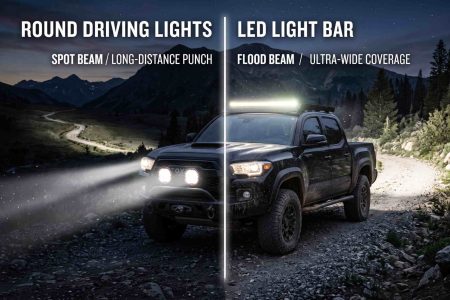
They solve different geometry problems. A 360° LED warning beacon specified as a J845 device spreads light across 360° horizontally and from 5° above to 5° below horizontal, which suits a vehicle whose orientation relative to traffic is unpredictable. A directional device specified as a J595 device concentrates its output into a 20° left and right, 10° up and down cone, which suits a defined approach axis such as traffic coming from behind. A wide low-profile bar gives a large visible face to a broad audience; a compact beacon covers all four vehicle zones from one position. Several vehicles use both, and both shapes are represented in the LED warning lights collection.
How do I check an R65 or J845 claim before buying?
Ask for four things: the certificate number, the issuing body and testing laboratory, the exact model number the certificate covers, and the validity dates. Certificates are written per model rather than per product family, so a certificate for a flagship lamp does not cover a compact one. Then check the physical approval mark on the lamp — an E in a circle, a country code, the regulation number and an approval number for R65 — against the certificate. A supplier who offers a logo instead of a document has not demonstrated anything. This four-step verification is the highest-value ten minutes in the entire purchase.
Editorial note
Written by SAEC Lighting Engineering Team, Foshan.
This buying guide separates verified primary sources from manufacturer claims and secondary industry reporting, and it states the evidence grade in the sentence that uses each number. Three gaps are worth repeating at the end. The ECE R65 regulation text could not be retrieved while preparing this guide, so no R65 candela threshold or frequency band is asserted as fact, and the two industry sources consulted describe the class relationship in conflicting terms. The SAE J845 and J595 scope documents were not obtainable, so the coverage angles and the Class I, II and III use categories are presented as the common industry interpretation supported by a manufacturer technical page, and no J845 minimum intensity values are quoted. The zoning, height, flash-rate and current figures attributed to NFPA 1901 come from a 2018 FAMA buyer’s guide summarising that standard rather than from the standard itself, so verify them against the current edition before writing them into a contract. State and national colour and use rules vary and were verified only for the jurisdictions cited; check the law where the vehicle is registered and operated. Product specifications attributed to specific SAEC models are manufacturer claims on those product pages and are labelled as such throughout.
Last updated: 2026-10-14
Sources
- Grote Industries, “SAE Standards & Certifications”, https://www.grote.com/technical-tips/sae-standards-certifications/ (page carries no stated publication date)
- FAMA, “TC044 Buyer’s Guide — Warning Lights” (PDF, document 180404 dated 2018-04-04), https://www.fama.org/wp-content/uploads/2018/04/TC044-Buyers-Guide-Warning-Lights-180404-2.pdf
- Minnesota Statutes, section 169.64, “Vehicle lights and equipment”, https://www.revisor.mn.gov/statutes/cite/169.64 (2025 edition)
- Wisconsin Statutes, section 347.07, “Special restrictions on lamps”, https://docs.legis.wisconsin.gov/statutes/statutes/347/ii/07 (2023–24 edition, updated to 2025 Wisconsin Act 247)
- The Road Vehicles Lighting Regulations 1989, Regulation 16, https://www.legislation.gov.uk/uksi/1989/1796/regulation/16/made
- The Road Vehicles Lighting Regulations 1989, Schedule 16, “Requirements relating to warning lamps”, https://www.legislation.gov.uk/uksi/1989/1796/schedule/16/made
- The Road Vehicles Lighting Regulations 1989, Regulation 26, https://www.legislation.gov.uk/uksi/1989/1796/regulation/26/made
- The Road Vehicles Lighting Regulations 1989, Regulation 17, “Warning lamps to be fitted”, https://www.legislation.gov.uk/uksi/1989/1796/regulation/17/made
- FHWA, “Manual on Uniform Traffic Control Devices 2009, Part 6, Chapter 6D: Pedestrian and Worker Safety”, https://mutcd.fhwa.dot.gov/htm/2009/part6/part6d.htm
- 49 CFR 393.95, “Emergency equipment on all power units”, govinfo CFR 2024-10-01 edition, https://www.govinfo.gov/content/pkg/CFR-2024-title49-vol5/xml/CFR-2024-title49-vol5-sec393-95.xml
- HELLA, “Beacons” product brochure (PDF; no stated publication date), https://www.hella.com/techworld/assets/documents/526_HELLA_Beacons_Brochure_EN.pdf
- Agri-Lighting, “ECE R65 Beacons: What the Regulation Means and Why It Matters”, published 2026-04-25, updated 2026-10-13, https://agri-lighting.co.uk/tractor-lighting/types/ece-r65-beacons/
- Liyi Signal, “ECE R65 LED Light Bar Certifications Explained”, published 2026-08-19, https://www.liyi-signal.com/ece-r65-led-light-bar-certifications-explained-what-buyers-actually-need-to-know
- HELLA Tech World, “Optical Warning Systems”, https://www.hella.com/techworld/us/passenger-car-parts/vehicle-lighting/optical-warning-systems/ (page carries no stated publication date)
- SAEC Lights, “Hornet SL LED Warning Light (Amber/Red/Blue) | R65 & J845 Certified” product page (manufacturer self-description), https://saec-lights.com/product/hornet-sl-led-warning-light/
- SAEC Lights, “Surfboard Mini LED Warning Light (Amber/Red/Blue) | R65 & J845 Certified” product page (manufacturer self-description), https://saec-lights.com/product/surfboard-mini-led-warning-light/
Sources consulted but not used as evidence, because the content could not be retrieved: the UNECE ECE R65 regulation document (access blocked and empty response from the UN digital library), the SAE standards pages and the ANSI webstore listings (script-rendered pages and an access error), the California Highway Patrol 884 equipment list (download succeeded but text extraction failed), the NFPA 1901 standard itself (paid document, not obtained), OSHA 1926.601 and FMCSA pages (access error), and the Texas Transportation Code Chapter 547 (navigation only).
 by


