


On this page
An LED fog lamp is worth buying only when its beam pattern, test evidence and vehicle fit agree with the job. A bright pod with no defined upper cut-off is not made into a fog lamp by a product title or a yellow lens.
This LED fog light buying guide gives you a way to compare actual lamp evidence before you shop. It separates photometry from marketing language, US and UN approval contexts, physical fit, wiring and final aim; local rules and the vehicle maker’s instructions still decide where and how a lamp may be used.
Quick answer: buy a beam, not a label
Start with the task. A front fog lamp is a forward lamp intended for conditions such as fog, rain, snow or dust; SAE J583 provides test procedures, performance requirements, design and installation guidance for the device. That is a much narrower job than producing the most light in every direction. A general-purpose flood pod, a driving beam and a fog beam may share a housing size while producing very different light distributions.
Before ordering, ask the supplier for the exact lamp model, its tested pattern or regulatory approval, the report or approval number, and the installation conditions attached to that evidence. Then verify that the housing, bracket, connector and switching arrangement fit your vehicle. If the seller cannot connect a claimed fog function to evidence for the exact configuration, treat the function as unverified. This LED fog light buying guide keeps the model identity attached to each claim so that a similar-looking product cannot inherit another lamp’s test result.
| Purchase question | Evidence to request | Do not substitute |
|---|---|---|
| Is it a front fog lamp? | Exact-model photometry report or applicable approval | “Fog,” “wide,” or “SAE style” in a listing title |
| Is the beam controllable? | Visible upper cut-off and a repeatable aiming method | High raw lumen number |
| Does it fit? | Dimensions, bracket range, connector and vehicle clearance | Similar-looking product photos |
| Can it be used on-road here? | Approval scope plus local installation/use rules | A generic DOT, E-mark or SAE logo |
For an overview of why auxiliary lamps need careful positioning, see the site’s auxiliary-light aiming and glare guide. That broader safety discussion is not a substitute for product-specific fog-lamp evidence.
What a front fog lamp is designed to do
The SAE J583 preview defines a front fog lamp as a lighting device intended to provide forward illumination under fog, rain, snow or dust. The description defines the purpose, not a promise that every weather event will improve when a driver adds lamps. Fog-scattered light can reduce target-to-background contrast, as discussed in an NHTSA review of advanced front lighting research. Visibility, speed, following distance and correct use remain central; a lamp cannot restore contrast the atmosphere removes. The National Weather Service advises using low beams, using fog lights if equipped, and avoiding high beams in fog.

For a buyer, the defining feature is a controlled distribution rather than a broad glow. The lamp should place useful light low and across the near roadway while controlling light above the beam. A visible cut-off provides an aiming cue; photometric measurements determine whether the distribution stays within the specified bright and dark regions. The SAE material defines cut-off and gradient as measurable concepts, while the UN/EU aiming text describes a cut-off line used for adjustment.
This is why a product photo of a bright foreground is weak evidence. Exposure, camera processing, distance and aim can make a poor pattern look persuasive. Ask whether the evidence concerns the exact lamp, lens, LED configuration and mounting orientation being sold. A clear lens, amber cover, or change in output mode may create a different tested configuration; do not assume the base model’s documentation covers every option. In an LED fog light buying guide, the photo is context, while the report is performance evidence.
Fog, driving and off-road beams solve different problems
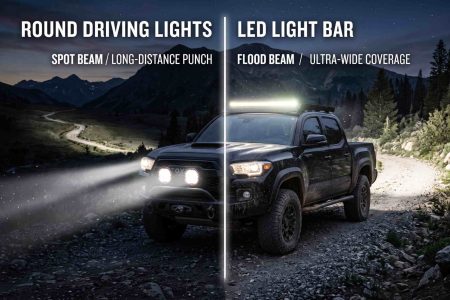
“Wide” is not a regulated beam definition by itself. A fog distribution is generally selected to spread controlled light near the vehicle and show a usable upper boundary; a driving beam concentrates more light farther ahead; an off-road flood or spot may prioritize work-area coverage without a road-use photometric boundary. The actual beam must be verified from photometry, a pattern plot, or a credible test report for the exact lamp.
Use the pattern plot as a comparison tool, not as artwork. Check axes, units, test voltage, lamp orientation, reference axis and whether the plot identifies a recognized test. A clean camera image on a wall can help you assess whether the lamp can be aimed, but it cannot replace a laboratory measurement. A fuzzy edge or stray light above the intended cut-off is a reason to ask questions, not a pass/fail determination by itself.
| Beam description | Intended buyer question | Evidence that helps | Typical mismatch |
|---|---|---|---|
| Front fog | Is there controlled near-field light and a usable cut-off? | Exact-pattern report, approval scope, aim instructions | Treating a bare wide flood as a fog lamp |
| Driving | Does the lamp extend forward illumination for suitable conditions? | Driving-beam test/approval and switching instructions | Expecting a driving beam to be a low fog beam |
| Off-road flood | Does it illuminate a nearby work or trail area? | Beam plot, mounting and use instructions | Assuming off-road output is road-legal |
| Off-road spot | Does it concentrate light toward a distant target off-road? | Beam plot and installed aim | Using it around oncoming traffic |
The SAEC light-bar mounting guide discusses how location affects auxiliary light. Fog lamps usually occupy a lower forward position, but the acceptable mounting point and minimum/maximum height are jurisdiction- and vehicle-dependent. The article’s general mounting concepts do not establish legal fog-lamp fitment for your vehicle.
Read the cut-off and distribution evidence
SAE J583’s public preview describes a cut-off as the visual or optical aiming cue separating higher- and lower-luminance regions, and says gradient measures the change in light level across a beam. That makes cut-off quality useful to inspect: a lamp that cannot produce a stable, clear boundary is difficult to aim consistently. The full SAE standard is a paid technical document, so this article does not reproduce its complete photometric tables or claim a numerical pass criterion from a summary page.
Request a report that names the exact model and shows the test arrangement. Verify that the test uses the correct voltage, mounting orientation, and lens/accessory configuration. If the report compares several lamps, check whether it was produced by an independent laboratory, whether the results are complete, and whether the tested units match the current item being sold. A cropped image with no model number, axes or report author cannot support a technical conclusion.
One published comparative report by a lamp retailer illustrates why the full distribution matters: it reports lamps with different cutoff sharpness, patterns and outcomes under its stated J583 test procedure. That is an example of a product comparison, not a universal ranking or proof that those results apply to a different lamp or future revision. Treat independent test reports as product-specific evidence and inspect the method before accepting the conclusion.

Separate a standard reference from an approval claim
SAE J583 is a technical standard for front fog lamps. SAE’s page identifies a verified May 2020 revision and describes its scope; the US Defense Logistics Agency ASSIST record also describes J583’s scope and lists an active status in that record. These facts do not establish that every lamp advertised as “J583 style” was tested, passed, or is legal in every place. Ask for the exact model’s report, marking and certificate details.
The UN/EU framework uses its own regulation and approval documents. The EU publication of UN Regulation 48 includes a front fog-lamp cut-off and aiming procedure; the actual vehicle installation rules must be checked in the applicable current text and jurisdiction. A lamp’s E-mark is not interchangeable with a US SAE test claim, and a US performance reference is not automatically a UN approval. The mark should match the correct regulation, function, approval number and lamp configuration.
| What the listing says | What you need to confirm | Why the distinction matters |
|---|---|---|
| “SAE J583” | Exact lamp model and evidence of its test/claim basis | A standard reference alone does not identify the unit’s result |
| “DOT” | Meaning and scope of the specific marking; seller’s supporting documents | Do not infer a fog function from three letters alone |
| “E-mark” | Regulation number, approval number, function and configuration | Different regulations cover different lamp functions and installations |
| “Road legal” | Country/state, vehicle, position, switching and use conditions | Laws and installation rules vary by jurisdiction |
NHTSA explains in a separate supplemental-beam interpretation that federal requirements distinguish original equipment and replacement equipment from aftermarket accessories, and its interpretations discuss the prohibition on commercial installers making required lighting inoperative. NHTSA also says a particular auxiliary-lamp installation must be assessed in context. That federal interpretation is not a summary of state laws or a universal permission for an owner to use any lamp. Check local rules and professional installation requirements before purchase. The practical rule for an LED fog light buying guide is to treat jurisdiction and installation as separate checks.
Match the lamp to your country and vehicle
Choose your regulatory path before comparing products. Write down the country where the vehicle is registered, the vehicle category and model year, whether the lamp replaces an original assembly or is an added accessory, and whether the intended use is public road or off-road only. These details change which approvals and installation instructions matter. A product sold internationally may have several versions that share a photograph but differ in marking, lens, wiring or certification.
For US buyers, read NHTSA’s interpretation material carefully: the agency’s interpretation of federal requirements does not decide every state rule and does not make every aftermarket configuration lawful. For vehicles subject to UNECE rules, identify the current applicable regulation and approved function. Do not rely on an online chart copied from a different year, market or vehicle class. If the vehicle has a body control module, adaptive lighting, factory fog-lamp monitoring or a multiplexed switch, ask the vehicle maker or a qualified installer whether an auxiliary interface is supported.
Keep a copy of the listing, model label, approval document, wiring sheet and installation instructions. If the product page makes a broad road-use statement, ask the seller to state the intended jurisdiction and the exact configuration covered. A response that only repeats “DOT approved” or “E-marked” without identifying what was approved leaves the central question unanswered. Pause the purchase until the seller supplies enough information to verify the claim independently.
Check size, mounting and vehicle clearance
Measure the available opening before selecting a lamp. Record opening width and height, depth behind the bumper or grille, bracket footprint, fastener access and the full adjustment envelope. Include the harness bend radius and connector body; a lamp may fit through the opening yet be impossible to connect or aim once the bumper is installed. Check whether the bracket permits vertical and horizontal adjustment after the fasteners are tightened.
Inspect what sits around the proposed lamp. A grille bar, tow hook, winch fairlead, intercooler, parking sensor, camera, radiator shutter or license plate can block the beam or constrain the mounting point. Moving the lamp to a different place to clear an obstacle may change its alignment, sensor interaction, legal position or vulnerability to impact. Verify front-end service access and confirm that no sharp edge can chafe the wiring.
Mounting options are not interchangeable. A flush mount can look integrated but may need a vehicle-specific bezel and enough rear depth. A pedestal bracket can be easier to aim or replace, but it exposes hardware and may vibrate if the support is weak. A universal bracket is only a range of possible attachment points; it does not prove compatibility with the vehicle. The LED light pod category and Clone 3.5-inch pod listing are examples of product formats to inspect for size and mounting questions. Their category or product name does not certify a fog-beam pattern or on-road approval.
Confirm the complete electrical interface
Compare voltage range, current draw at the vehicle’s operating voltage, connector type, polarity, wire length, switch arrangement and controller requirements. The product page should distinguish lamp current from a recommended fuse or harness rating. Those are related but not identical: the fuse protects a conductor, so its selection must match the harness design and installation instructions. Do not choose a fuse solely by multiplying a marketing wattage claim or by copying a generic online diagram.
Ask whether the lamp includes a harness, relay, fuse, switch, connector or vehicle-specific adapter, and whether any item is sold separately. For a pair, confirm whether the quoted current is per lamp or for the pair. Check the vehicle’s owner information for accessory power limits and determine whether the proposed circuit is permitted. Modern vehicles may switch or monitor lighting outputs in ways that make a direct tap unsuitable. Avoid airbag circuits, safety systems and unknown control wires.
Grote’s product specification page is a useful example of detail a buyer can ask for: one listed fog-lamp model specifies a 12–36 V range, 1.42 A at 12 V, a two-wire pigtail, a DT plug, bracket mounting and product-specific standards. Those numbers belong only to that named model and must not be transferred to another lamp. If the seller of your candidate cannot provide equivalent exact-model information, regard the unknowns as unresolved rather than estimating from appearance. Keep these fields together as a one-page LED fog light buying guide scorecard when you request quotations.
| Electrical item | Ask the seller or installer | Record before purchase |
|---|---|---|
| Input voltage | What exact DC range is supported? | Vehicle nominal system and actual equipment requirement |
| Current | Per lamp or pair, at what stated voltage? | Pair current and circuit capacity evidence |
| Connector | What connector and pinout are supplied? | Mating connector, sealing and service method |
| Control | Is a relay, controller, dimmer or CAN interface required? | Included parts and compatible vehicle interface |
| Harness | What conductor and fuse instructions are supplied? | Route length, protection, grommets and support points |
Choose lens colour with evidence
Do not choose amber or yellow solely because it is marketed as “cuts through fog.” Colour changes spectral distribution and appearance, but it does not fix poor beam control, excessive glare, a misplaced hotspot or an unsuitable aim. SAE J583 and relevant international rules specify lamp performance and colour requirements within their own contexts; the actual acceptable colour depends on the applicable standard and jurisdiction.
Ask whether the coloured output is part of the tested configuration. A removable cover, selective-yellow lens, amber LED mode or aftermarket film may alter transmission and photometry. The evidence for the clear configuration may not cover a yellow cover, and a dual-colour lamp may have separate functions with different approval status. Confirm whether the approved mode is fixed, switchable, or only for off-road use and how the control is wired.
Colour selection should follow evidence and use conditions. For a public-road fog lamp, use only the colour allowed for the applicable vehicle and jurisdiction, then verify that the exact assembly carries documentation for that colour. For a trail-only pod, label the intended use and plan a separate control that prevents inappropriate road use. If the seller cannot say whether an accessory changes approval scope, do not assume it is harmless because it clips over the lens.
Verify the physical and environmental construction
Look for the lens and housing material, sealing method, thermal design, connector seal, corrosion protection, fastener material, operating temperature, vibration evidence and warranty. A product specification should say what the manufacturer claims and how the claim applies to the assembled lamp. An ingress-protection code, when provided, relates to a specified test; it does not by itself demonstrate fog photometry, salt resistance, long-term connector reliability or correct installation.
SAE J583’s public preview lists environmental test procedures associated with the standard, including vibration, moisture, dust and corrosion references. Use this to make a practical request: ask for evidence tied to the exact lamp, and ask whether the product was tested in its final mounting orientation. A lens can remain intact while a bracket loosens; an enclosure can be sealed while an exposed connector corrodes. Look for the weakest installed interface, not only the lamp shell.
Review replacement parts and repairability. Can you replace the bracket, connector pigtail, lens cover or a damaged harness without replacing the whole assembly? Is the product available as a pair or singly? How is condensation handled by the manufacturer? An answer such as “fully waterproof” has little value without a defined rating, test condition and warranty scope. Save the written specification because product pages can change.
Check light output claims the right way
Raw lumens describe total emitted luminous flux under a measurement condition; they do not show where the light lands. For fog-lamp shopping, a beam plot and photometric test points are more informative than a large lumen number. Ask whether the published value is measured output or LED-source calculation, whether it is per lamp or per pair, and whether it reflects steady operation after the lamp warms up.
Compare photometric distributions from the same type of test. Check that plots use the same scale and reference points. A graph that crops the high-intensity region or changes scale between lamps can create a false impression of a wider or stronger beam. If the manufacturer provides only lux photographs, ask for distance, alignment, detector, exposure settings and lamp voltage. Camera exposure can make a low-output lamp appear brilliant or a controlled cut-off look less distinct.
Useful output is a balance. Light too low may brighten the immediate foreground while leaving distant road cues dark; light too high may increase glare and impair other road users. The right selection is the model with a tested distribution appropriate to the intended function, installed and aimed as instructed. A product that produces a visually broad field is not automatically better than a narrower lamp with a verified boundary.
Evaluate seller and test-document quality
A credible document should identify the manufacturer, exact model, revision or configuration, test standard and edition, laboratory or approval authority, test date, result, and any conditions. For a homologation claim, check the approval number against an official or competent authority source when available. For a standards claim, request a report that states what was tested and passed; a standard number in a catalog is not the report.
Look at the reporting scope. Did the test cover one product, a family of variants, or a component? Was the lamp tested with the same lens, LED board, driver, cover and bracket you will receive? Does the report record all relevant tables or only a selected chart? If a report is proprietary, a redacted page can still identify the lamp and conclusion, but it should not remove the details needed to verify the claim.
The retailer-hosted J583 comparison report linked below demonstrates how products may be measured and why results differ, but the retailer also has a commercial interest. Read its methodology and treat the findings as that report’s data, not an independent guarantee for every item. Prefer traceable third-party reports or official approval records where available. When the only evidence is a marketing badge, classify the performance and approval claims as unverified.

Plan installation and aiming before you order
The lamp needs a stable mount and an adjustment method that works on the vehicle. Before drilling, confirm the chosen position against the vehicle manual, sensor layout and local requirements. Use existing brackets or mounting points only when their capacity and instructions suit the load. Avoid mounting to a thin plastic cover unless the vehicle manufacturer or lamp instructions explicitly support it. A heavy lamp on a flexible panel can lose aim after vibration.
Plan where the harness will pass through the body. Use a protected grommet at each opening, secure the loom away from heat and moving components, and leave enough slack for service without allowing it to rub. Protect the circuit as directed by the lamp maker and a qualified installer. Disconnecting a battery, interacting with a restraint system, drilling into an unknown panel, or altering a monitored circuit can carry vehicle-specific risks; stop and use a professional if the route or control is unclear.
Aiming must follow the lamp maker’s instructions and the applicable procedure. The EU publication of UN Regulation 48 describes a horizontal cut-off and aiming procedure for front fog lamps; its specific nominal angle applies within the stated symmetrical-lamp procedure and must not be copied as a universal workshop setting. Vehicle load, lamp height, traffic side and regulation can change the correct reference. Use a level floor and the manufacturer’s target, then recheck after the first drive or any bracket service.
Use a short installation and handover checklist
Commission the system in a controlled setting before driving in traffic. Check fastener torque against the manufacturer’s instructions, harness support, connector engagement, fuse placement and switch operation. Verify that the lamp does not block a required lamp, sensor, plate or cooling opening and that both lamps point as intended. Confirm that any automatic or vehicle-integrated switching behaves correctly through every relevant lighting mode.
Observe the beam on a suitable flat surface or use a professional aiming device. Do not judge glare by standing in front of a high-output lamp at close range, and do not adjust by eye while other road users are exposed. If the cut-off is unstable, asymmetric when the product should be paired, or impossible to align with the instructions, inspect the mount, lamp orientation and unit identity. A poor result should be corrected before use, not compensated by pointing the lamp lower without evidence.
Document the installed model, approval details, wiring path, fuse and aiming reference. Keep the report, instructions and purchase record with the vehicle’s maintenance information. This makes it easier to replace a damaged unit with the same configuration and to explain the installation during servicing or inspection. If the final system differs from the tested configuration—for example, a different cover, control mode or mounting orientation—record that difference and confirm with the supplier or qualified installer whether the evidence still applies.
Compare candidates with a buyer scorecard
Do not assign a high score to a claim that is merely repeated in advertising. Mark a field “verified” only when the evidence names the exact item or the relevant vehicle application. “Unknown” is a useful decision: it identifies the question that must be answered before ordering. If a key field remains unknown, compare another product rather than making a guess from price or appearance.
The scorecard below intentionally weights evidence and fit ahead of decorative options. You can add your own cost, warranty and service priorities, but keep the road-use check as a gate rather than averaging it against a low price. A lamp that does not fit the vehicle or lacks the required approval cannot be rescued by more points for a stylish housing.
| Check | Candidate A | Candidate B | Pass condition |
|---|---|---|---|
| Exact-model fog photometry/approval | Unknown / verified | Unknown / verified | Evidence matches the sold configuration |
| Cut-off and aiming instructions | Unknown / verified | Unknown / verified | Repeatable method and stable mount |
| Vehicle opening and depth | Measure | Measure | Clears trim, sensors and service parts |
| Electrical data and connector | Unknown / verified | Unknown / verified | Matches vehicle and installation plan |
| Local use conditions | Confirm | Confirm | Applicable rule checked for intended use |
| Warranty and replacement parts | Compare | Compare | Scope is written and practical |
When to reject a candidate
Reject or pause when the supplier will not identify the exact model; the product uses “fog” as a keyword but offers no fog-pattern evidence; the claimed approval cannot be connected to a regulation, marking or configuration; or the mount cannot hold the lamp’s aim. Also pause when the installation would interfere with required lighting, a sensor or an airbag zone, or when no safe power and wire route is documented.
Reject a product page that substitutes a generic light-bar image for the actual lens and bracket, uses lumen claims without stating whether they are measured or calculated, or provides a beam photograph without distance and exposure context. These shortcomings do not prove the product is defective; they mean the buyer lacks enough evidence to select it responsibly. Request the missing documents once, in writing, and move on if the response remains vague.
Do not buy a lamp with the expectation that an installer can “aim it legal” after the fact. Aiming cannot turn an unsuitable beam distribution into a tested fog lamp, and a legal marking does not override a conflicting vehicle application or local use rule. Purchase the right function and evidence first; installation is the final verification step.
Frequently asked questions
Are more lumens better for a fog lamp?
Not by themselves. Total lumens do not describe the shape or control of the beam. Compare the exact lamp’s photometry and tested configuration, then verify that the beam can be aimed as instructed.
Does a yellow lens prove a lamp is a fog lamp?
No. Colour alone does not establish function, photometry or approval. Confirm that the exact coloured configuration is allowed and supported by the relevant test or approval evidence.
Is “SAE style” the same as tested to SAE J583?
No. A style description is not proof of a test result. Ask for the exact model’s documentation and the test standard edition, or treat the claim as unverified.
Can I install any E-marked lamp as a fog lamp?
No. The marking must identify a relevant approved function and configuration, and vehicle installation and local-use rules still apply. Confirm the approval details rather than relying on the mark alone.
Can an off-road pod work as a road fog lamp?
Only if the exact lamp configuration has appropriate evidence and its installation/use is permitted where you drive. A wide beam or low mounting position alone does not establish compliance.
Should I wire a fog lamp into a factory circuit?
Only when the vehicle maker and lamp instructions support that connection. Modern vehicles may monitor or switch lamp circuits electronically; ask a qualified installer when the wiring or interface is uncertain.
Editorial note
SAEC Lighting Engineering Team, Foshan Last updated: 2026-11-02
Sources
- SAE International, “J583_201510: Front Fog Lamp” (page identifies verified May 2020 revision): https://saemobilus.sae.org/standards/j583_201510-front-fog-lamp
- SAE International, “J583 May 2020” public preview (definitions and referenced tests): https://www.normsplash.com/Samples/SAE/185497711/SAE-J-583-2020-en.pdf
- U.S. Defense Logistics Agency, “ASSIST-QuickSearch Document Details: SAE-J583”: https://quicksearch.dla.mil/qsDocDetails.aspx?ident_number=55663
- NHTSA, “NHTSA’s Interpretation Files Search” (aftermarket auxiliary-light interpretation on page): https://www.nhtsa.gov/interpretations-search?page=1
- NHTSA, “571.108—Supplement beam—Boykin—16-0884”: https://www.nhtsa.gov/interpretations/571108-supplement-beam-boykin-16-0884
- NHTSA, “Survey of Advanced Front Lighting Research” (weather visibility and scattered light discussion): https://www.nhtsa.gov/sites/nhtsa.gov/files/survey_of_advanced_front_lighting_research.pdf
- National Weather Service, “Driving in Fog”: https://www.weather.gov/safety/fog-driving
- Official Journal of the European Union, UN Regulation No. 48, “Uniform provisions concerning the approval of vehicles with regard to the installation of lighting and light-signalling devices,” 30 September 2021: https://op.europa.eu/en/publication-detail/-/publication/db34f4ef-21c4-11ec-bd8e-01aa75ed71a1/language-en
- Grote Industries, “LED Fog Lamps” (product-specific specification example): https://www.grote.com/white-light/forward-lighting/led-fog-lamps/
- Cal Coast Motorsports / Morimoto, “SAE J583 Test Results” (retailer-hosted comparative report; results limited to its described tests and lamps): https://www.morimotohid.com/docs/Calcoast%20SAE%20J583%20Full%20Report.pdf
- Wikimedia Commons, “07 Driving in fog – car in low visibility dangerous weather conditions,” Marek Ślusarczyk, CC BY 3.0: https://commons.wikimedia.org/wiki/File:07_Driving_in_fog_-_car_in_low_visibility_dangerous_weather_conditions.jpg
 by


