


On this page
An LED light bar’s kelvin rating describes the apparent color of its white light; it does not tell you how far the beam reaches, how well it reveals a target, or whether it performs better in fog. Choose color by comparing the actual spectrum, beam distribution, output, mounting position, weather, and task under controlled conditions. A 5000K lamp is not automatically better than a 6000K lamp, and amber is not a universal visibility upgrade.
That is the central point of any LED light bar color temperature comparison: identify what the CCT number does and does not measure before using it to choose a product.
Prepared by the SAEC Lighting Engineering Team, Foshan. This guide separates color appearance from measured visibility and road approval. Last updated October 12, 2026.

What does color temperature measure?
Correlated color temperature, abbreviated CCT, is a way to describe the chromatic appearance of a light that looks approximately white. It is expressed in kelvins (K). In familiar terms, lower CCT white tends to look warmer or more yellow, while higher CCT white tends to look cooler or more blue. The term does not mean that an LED chip is physically heated to the advertised temperature. A 6000 K LED package is not operating at 6000 kelvins as an object; the number expresses a colorimetric comparison with a theoretical reference radiator.
The CIE definition makes the comparison precise: CCT is the temperature of the Planckian radiator whose chromaticity is nearest to the test source’s chromaticity on a specified color space diagram. The CCT is therefore a description of a point derived from the source’s color appearance, not a direct description of all wavelengths emitted by the source. A light source that sits too far from the Planckian locus should not be summarized by CCT alone. That limitation matters for some colored and unusual LED spectra. CIE’s definition of correlated colour temperature identifies kelvin as the unit and explains its nearest-chromaticity basis.
For a buyer, the practical rule is simple: use CCT to compare the general appearance of similar white sources. Do not use it as a stand-in for lumen output, candela, lux, beam width, glare, color fidelity, electrical load, or weather performance. A label that says “6000K” says nothing by itself about how much light reaches the shoulder, whether the optic produces a usable cutoff, or how a red recovery strap appears under the lamp.
The word “temperature” can encourage a misleading mental model. The CCT scale is based on the color of a reference radiator as its temperature rises, but an LED creates its color through a semiconductor and its surrounding optical and phosphor system. A phosphor-converted white LED can combine a blue LED with phosphors that convert some of that energy into longer wavelengths. Another device can mix multiple colored LED channels. The methods produce a white visual impression by very different spectral routes. The U.S. Department of Energy describes phosphor-converted, color-mixed, and hybrid white LED methods, and notes that CCT compresses color-coordinate information with significant loss. DOE’s LED Basics is useful background on those system differences.
For a buyer researching LED light bar color temperature, that definition separates the appearance label from actual operating heat, electrical load, and useful beam output.
The light’s CCT can also appear different from what a buyer expects because the same nominal value does not capture every chromaticity direction. Two products that both claim 5000 K can differ in their distance from the reference curve, often described through Duv or chromaticity coordinates. One may look greener while another appears more pink or neutral. Product tolerance, binning, optics, measurement method, and the observer’s surrounding adaptation can all affect how the installed lamp looks.
Think of CCT as the first line of a description, not the final verdict. It can help you rule out a color family that you dislike or compare products whose appearance matters to your work. It cannot tell you which beam is safer, which lamp provides more usable seeing distance, or which spectrum gives the best recognition of every object. To answer those questions, inspect more complete technical and photometric evidence and, when possible, view the exact fixture in the location where it will be used.
How do 5000K and 6000K look different?
On a typical white-LED product label, a 5000 K source usually looks neutral-to-cool white, while a 6000 K source usually looks cooler and more blue-white. The difference is one of appearance, not an automatic ranking of brightness or quality. A 6000 K product is not necessarily more intense, higher in lumen output, longer reaching, or more efficient than a 5000 K product. Those properties depend on the LED package, driver, heat management, optic, input voltage, and measurement conditions.
When comparing LED light bar color temperature, keep the beam shape and measured target illumination beside the kelvin value so that color appearance is not mistaken for output.
The visual step between 5000 K and 6000 K may look modest in a product grid and more noticeable when two lamps are mounted together. At night, adaptation to darkness and surrounding light can alter the impression again. A lamp that seems neutral in a bright retail setting may look distinctly cool on an unlit trail. The color of the surface also matters. Pale dust can take on a blue cast; dry grass may look more golden; gray rock may seem slightly different even when the illuminance on the target is unchanged.
The exact number is not a paint chip. CCT is a colorimetric summary, not a guarantee that every 5000 K product will look identical to another 5000 K product. Chromaticity tolerances, Duv, the spectrum, optical coatings, lens tint, and other light sources in the scene can alter the perceived result. A claimed 6000 K may appear more neutral or more blue than another product with the same claimed number. Manufacturers can also round values or state a nominal range rather than an independently measured value for each unit.
The DOE explains that CCT summarizes a source’s color coordinates with information loss, while the spectral power distribution (SPD) preserves far more detail about energy across wavelengths. The department’s LED color-characteristics fact sheet also notes that sources with the same CCT can appear different when their chromaticity differs in the green-to-pink direction. In practical purchasing, that means a buyer who strongly dislikes a green cast should seek chromaticity or Duv data, consistent product photography under known conditions, or a sample inspection rather than trusting “5000K” alone. DOE’s Color and Spectrum resources discuss the use of CCT alongside distance from the Planckian locus.
Do not infer a direct visibility advantage from the color label. If two 5000 K and 6000 K lamps have different optics, mounting angles, center intensity, spill, and measured output, a road or trail comparison confounds several variables. The lamp that looks whiter could also be brighter at the target, or it may create more reflected light from nearby haze. A fair comparison would control those physical and photometric differences before attributing the outcome to CCT.
For mixed-use trucks, a neutral white light can feel familiar when it is similar to other installed lamps, while a cooler source can make the overall setup appear more blue. That may be a personal preference rather than a measurable performance difference. For color-critical work, the chosen spectrum may affect object appearance even if the CCT looks pleasing. For trail scouting, the relevant issue may instead be how much usable contrast reaches the ground and how much light returns as glare. Separate those decisions instead of asking one Kelvin number to answer them all.
The practical comparison is therefore: 5000 K and 6000 K are both common white-light categories; each category can include products with very different spectra and beams. Compare light bars at the same target and in the same surroundings, then record what looks useful to the driver or operator. A preference for 5000 K is defensible as a preference. A claim that every 5000 K lamp sees farther than every 6000 K lamp needs controlled evidence specific to those products and conditions.

Why is CCT not a complete light specification?
The output of a light source can be represented by its spectral power distribution, or SPD: a curve that shows relative emitted power over wavelength. CCT reduces part of the source’s color appearance to one value. Two very different curves can produce a similar white appearance and therefore a similar CCT, while rendering colored objects differently. The number does not preserve the peaks, valleys, or relative energy that make up the complete spectrum.
This is why an LED light bar color temperature label cannot replace spectral or photometric evidence when the task involves recognizing real objects.
That distinction matters in automotive auxiliary lighting because a driver sees surfaces, not a bare CCT value. A red marker, a blue recovery rope, a brown branch, and a faded road edge reflect different portions of the source spectrum. If the lamp emits little energy in a wavelength region that an object reflects, that object may look darker or less distinct under that source than under a source with a different spectral balance. CCT cannot reveal that difference on its own. Nor can it tell whether an optical lens blocks some of the source spectrum or whether a filter reduces total transmission.
The DOE’s LED Basics page says that color appearance is often condensed to CCT with significant information loss, and distinguishes color fidelity as the effect of the source on the color appearance of objects. DOE also explains that LED systems can create white light through phosphor conversion, color mixing, or a hybrid method. These are reasons to treat a product’s spectrum, rather than only its CCT label, as the more complete description when the task depends on how objects look. DOE’s LED Basics summarizes those distinctions.
A color temperature number also does not tell you how the beam is distributed. A broad flood optic can send light over a nearby work area, while a narrow spot optic can concentrate light in the forward distance. Even identical LED packages can behave differently in different reflectors, lenses, housings, and thermal conditions. The distribution can change perceived brightness across the scene, and the location of a hotspot can matter more than small differences in nominal CCT. For that reason, always compare photometry and beam plots where available.
The CCT also omits operating conditions. An LED’s appearance and output can shift with temperature, current, driver behavior, voltage, and thermal stabilization. A lab test at one voltage or ambient temperature may not describe a lamp mounted behind a grille at idle, exposed to engine heat, or used for a long period at full power. Ask whether the specification applies to the assembled luminaire, which operating condition was used, and whether tolerances are reported.
For buyers, the useful order is: first define the visual task and target; next compare light distribution and measured intensity at the relevant angles or distances; then consider total usable output and spectrum; then use CCT as one appearance parameter. If the task requires reliable object color, also request CRI information or a richer method such as IES TM-30 when it is available. For route scouting, do not confuse color quality with beam reach. For recognizing colored equipment, do not assume a high lumen number or a preferred CCT will preserve every hue.
The word “white” can hide a lot of technical variety. A spectrum can be broad, have pronounced peaks, or be tuned to emphasize a selected color family. Two samples that look similar to a driver at first glance may produce a different appearance when placed side by side on the same target. A camera sensor may show a difference that is difficult for a human observer to see, or the camera’s automatic white balance may conceal a difference. A phone image is therefore not a laboratory spectrum measurement and should not be the sole method for choosing a color-critical work lamp.
If a seller offers only a Kelvin value, that may be adequate for a buyer whose main concern is a broad warm-or-cool preference. It is inadequate if the seller uses that number to promise visibility through fog, perfect color recognition, or equivalence between products with different optics. Ask for the actual test information that supports the claim. If it is unavailable, choose based on a real installation trial and state the limits of that judgment.
What can CRI tell you about color identification?
The color rendering index (CRI) describes how a light source makes a set of test colors appear compared with a reference illuminant. The general CRI value, commonly written as Ra, is a color-fidelity score. It does not measure brightness, beam reach, glare, contrast at a given distance, or a driver’s overall ability to detect an obstacle. It is useful only when the job includes object color appearance, and even then it is an incomplete summary.
The DOE advises that CRI is far from a perfect metric and is especially weak at predicting the fidelity of saturated reds; the supplemental R9 value is often used for that area. DOE also points to TM-30’s fidelity index (Rf) and gamut index (Rg) as a more comprehensive way to evaluate color rendition. These metrics describe aspects of how a source renders colors; they are not a replacement for measuring a vehicle light’s beam or testing the complete lamp in its intended position. DOE’s explanation of CRI and TM-30 makes that distinction clear.
NIST describes the common CRI Ra calculation in more detail: it simulates the appearance of 14 reflective samples under a test source and a reference source, while Ra averages the first eight samples, which have low-to-moderate chromatic saturation. NIST notes that the sample set and averaging approach can allow a high average even when one or two colors are rendered poorly. That is why a single CRI number should not be treated as a guarantee that every red wire, blue connector, or colored trail marker will be easy to identify. NIST’s overview of color rendering explains how Ra is formed and discusses its limits.
For general trail driving, color fidelity is not the same goal as visibility. Recognizing a rock edge, tree trunk, rut, or animal may depend on luminance contrast, beam placement, background clutter, distance, motion, and the driver’s visual state. A colored object can appear less familiar under a particular spectrum, but a high CRI reading does not by itself prove that an obstacle is detectable from farther away. Conversely, a source with a modest CRI may still provide a useful beam for an off-road task that does not rely on accurate color recognition.
For work-truck inspection, color rendering can matter more. A technician may need to distinguish wire insulation, identify fluid color, read a colored warning mark, or inspect paint. A driver may need to distinguish a red recovery strap from a dark surface. In those cases, look for both a color metric and a direct visual check of representative objects under the installed lamp. If the task has a professional standard or workplace specification, follow that document; do not decide that CRI 80 or 90 automatically satisfies it.
The correct questions to ask are: What metric is reported? Which test method and version? Does the value apply to the finished lamp or just the LED package? Is an R9 value or TM-30 report available? Were measurements made at the same CCT and operating condition as the purchased model? Are the relevant target colors included or do you need a practical mock-up? These questions turn a vague “high CRI” claim into evidence that can be compared.
Remember that “color rendering” is a lighting property, whereas “color recognition” is a task outcome. The source, illuminated target, visual adaptation, background, observer, and viewing distance all contribute to what the person can identify. A metric can help characterize the source, but the task still needs a test. When color matters enough to affect a repair, use a proper work light and inspection procedure rather than relying on an auxiliary bar as the sole source.
When does amber light make sense?
Amber is a distinct color option, not simply a low-CCT setting on the same white scale. A white light with a nominal CCT such as 3000 K remains a white source with a warm appearance; a selective amber or yellow light can have a substantially narrower or otherwise different spectral distribution. The two may look related to an observer, but the spectrum and optical transmission can differ. Ask the manufacturer what “amber” means for that particular lamp: a colored LED, a phosphor system, a filter, a replaceable lens, or a selectable channel.
Amber can be useful when the operator wants a warm-colored auxiliary beam, prefers the scene appearance, needs a separate lamp identity, or wants to reduce the amount of short-wavelength output reaching certain nearby surfaces. Those are practical use cases to evaluate, not a promise that amber light passes through every form of fog, rain, snow, or dust more effectively. Scattering depends on the particle size and distribution, the wavelength, the path length, the source position, the beam shape, the surface, and the observer’s adaptation. Real weather is not a single uniform filter.
A lens filter can also remove some wavelengths while reducing total transmission. If the underlying source starts as white, converting its visible output to amber with a filter may reduce the amount of light that reaches the target. A purpose-built amber LED can have a different efficiency and spectral profile. Comparing a yellow-filtered lamp with a white lamp at unmatched candela or illuminance confounds color and intensity. A fair test should report the actual light reaching the target, the beam pattern, and the color method.
The source of the amber appearance also affects object color. A narrowband or strongly shifted spectrum may make some surfaces easier to distinguish from others and make other colors look different or disappear into the background. If the task requires reading color-coded wiring, checking paint, recognizing trail markers, or identifying colored recovery equipment, test those exact objects. Do not assume “amber” means better contrast for every object. A red strap on brown earth, a blue tool on gray gravel, and a white animal against snow are different visual problems.
Owners sometimes choose amber because they feel it creates a calmer scene or reduces subjective glare in haze. Subjective comfort is a legitimate preference, but it should be kept separate from a measured safety claim. A lamp’s mounting height, aim, shielding, output, and beam cutoff may determine glare more strongly than whether the output is white or amber. If the source is aimed too high, even a preferred color can illuminate airborne moisture and create a bright veil close to the vehicle.
Consider where the light will be installed. A low-mounted, properly aimed fog or scene lamp can have a different relationship with ground fog than a roof-mounted bar. A roof bar may put light into nearby branches, dust, snow, or moisture that reflects toward the driver. A bumper lamp aimed downward can illuminate the near road surface but has less reach over rises and obstacles. Those are geometric and photometric effects; changing CCT does not fix poor mounting or aim.
Amber is worth considering when the user has a specific task, a tested preference, and data about the lamp’s output and beam. It is not a substitute for correct road-approved headlights, a properly designed fog beam, suitable speed, or weather-appropriate driving. On a public road, the color and use of auxiliary lamps are subject to the regulations for the jurisdiction and device category. An off-road preference should not be treated as road-use approval.
What does research say about light color in fog?
Research findings about light color must be matched to the question the study actually tested. A study of pedestrian detection with experimental headlamp filters is not automatically a test of an LED light bar in mountain fog. A study of fixed roadway luminaires is not proof that a roof-mounted truck bar performs the same way. The source spectrum, photometric output, beam pattern, mounting height, fog density, target, observer, ambient lighting, and test distance all affect the result.
One U.S. Federal Highway Administration experiment examined spectral power distribution and driver performance using vehicle headlamps with white/yellow and white/blue filters. In the reported comparison, the mean pedestrian-detection distance was 64.5 m with the white/yellow headlamps and 56.7 m with the white/blue headlamps; the difference was statistically significant in that experiment. The report also states that the white/yellow filters transmitted 49 percent of light, compared with 44 percent for the white/blue filters. That means the groups differed in transmission, so the result cannot be assigned to color alone. The experiment concerned those headlamp/filter configurations and pedestrian-detection tasks, not an isolated comparison of commercial 5000 K and 6000 K light bars in fog. FHWA-HRT-15-047, Chapter 5 reports both the detection-distance results and the filter-transmission caveat.
A separate laboratory study indexed in PubMed examined road-lighting color temperature and road visibility under simulated night fog. Its reported result was conditional: lower-CCT road lighting was associated with longer visibility distance under fog conditions at approximately 102 m measured visibility, while higher-CCT light improved visibility under higher-visibility conditions. This is relevant evidence that effects may depend on the fog state, but the study investigated roadway lighting, not a vehicle-mounted auxiliary light bar. The lamp geometry and task are different. A reader should not convert that finding into an unconditional product claim. The study record and abstract identify its road-lighting and simulated-fog scope.
An SAE technical paper on front fog-lamp performance reviews how beam pattern, mounting height, and aim affect visibility in fog, including the balance among target luminance, fog veiling luminance, and glare to opposing drivers. Its emphasis is valuable for buyers because fog performance is not just source color: geometry and photometry matter. The paper’s abstract discusses modeling and lamp arrangements; it should be read within that scope rather than treated as a blanket statement about every modern LED auxiliary lamp. SAE Technical Paper 2000-01-0434 summarizes those factors.
These sources do not justify saying that yellow light “cuts through” all fog or that white light is always worse. Some studies show condition-specific advantages, while the factors and test configurations differ. Fog itself varies in droplet size, density, distribution, and visibility distance. The observer’s eye adapts to the ambient scene; the target may be white, dark, colored, reflective, moving, or partly hidden. A test that changes only color while retaining a different filter transmission is not a pure color comparison.
The useful takeaway is narrower and more practical: lower-CCT or amber sources can be worth testing for a defined low-visibility task, but the result depends on more than the color label. Choose a beam designed for its role, keep it correctly aimed, compare like-for-like photometry, and test on a safe closed course or work site. Do not reproduce hazardous weather or test auxiliary driving lights in public traffic. If weather has reduced visibility beyond safe driving limits, reduce speed or stop when conditions make travel unsafe; a color change cannot restore the distance that the atmosphere removes.
The “amber penetrates fog” slogan usually compresses several ideas into one phrase: longer-wavelength light may be scattered differently by some particle distributions; a colored filter may reduce short-wave output; a low, wide, cutoff beam may direct less light into nearby fog; and an amber lamp may feel more comfortable to an individual driver. Those statements are not equivalent. The effect of wavelength depends on the scattering regime, and a real fog bank is not composed of particles that all behave identically. If a product maker claims a quantified fog advantage, ask for the test setup, comparison lamp, fog density, target, distance, output, beam, and measurement method.
How do rain, snow, dust, and mud change the choice?
“Bad weather” combines conditions that affect light in different ways. Dense fog is made of suspended droplets; rain includes droplets and a wet reflective surface; blowing snow includes flakes and a bright ground layer; dust may be fine and dry or mixed with moisture; mud usually changes the reflectance of the terrain rather than the transmission of the air. A single CCT recommendation cannot represent all of those scenes.
In fog, close droplets can brighten when illuminated, creating a veil in the driver’s forward view. In rain, the wet road can create sharp reflections and glare, while the falling drops may return light in front of the vehicle. In snow, a high-output beam can make nearby flakes conspicuous and wash out part of the scene; white snow also reflects substantial light back toward the observer. In dust, illumination can reveal suspended particles and reduce contrast beyond them. In mud, the main issue may be dark, low-reflectance ground combined with uneven ruts and standing water. The geometry of the beam and the surface often matters at least as much as the source’s apparent color.
If the work takes place in blowing dust or snow, a very high roof-mounted light bar can illuminate a large volume of particles close to the driver. Lower-mounted lamps, side-facing work lamps, or a reduced-output setting may make the near field easier to use, depending on the task and legal context. Those are configuration choices to test, not universal prescriptions. Do not change a road-certified beam or lamp installation in a way that invalidates its intended function or approval.
In wet conditions, broad light directed onto the hood, water film, mirrors, or pale rock may create distracting reflections. The driver should check whether the beam lights useful ground or primarily the spray and body panels. A lower CCT can change the perceived color of wet surfaces; it does not eliminate specular reflections. Good lens cleaning, a stable mount, a suitable beam cutoff, and careful aim all remain important.
On snow, color may affect how familiar objects look and how the scene is perceived, but the most useful setup still depends on what must be identified. A warm source may make some targets easier to distinguish and can produce a different visual impression from a blue-white source. It can also change the appearance of signs, markers, and clothing. If someone else must read those colors accurately, verify with the exact objects and conditions rather than relying on a general statement that amber is better in snow.
For work sites with recurring adverse conditions, a practical assessment should record the weather, visibility range, lamp position, beam pattern, lens cleanliness, target distance, voltage, and the operator’s task. If several operators use the same machine, collect observations from more than one person. A preference that works for one observer’s night vision, eyesight, and color adaptation may not work equally well for another. Keep safety procedures primary: use the vehicle’s approved equipment for road travel, and switch off auxiliary lamps when they could dazzle others or impair the driver’s view.
Do not drive into a dangerous weather situation just to validate a color choice. A static test with the vehicle secured on a private site, a fixed target, and a safe observer position can show whether the beam creates a useful near-field scene. It cannot establish on-road stopping distance or regulatory compliance. Any required fog, headlamp, or work-light selection should come from the applicable vehicle and workplace rules.
How do terrain and reflective surfaces affect perceived color?
The ground is part of the lighting system. A lamp does not reveal a trail in isolation; it illuminates soil, gravel, plants, water, paint, metal, and objects that reflect different amounts and colors of light toward the driver’s eyes. A pale sandstone road, dark wet forest floor, dry grass field, and snow-covered track can look different under the same source. That is one reason a color comparison made on a parking lot may not predict what an operator sees on a real route.
Surface reflectance describes how much light a material reflects and how that reflection varies by wavelength and direction. A light-colored surface may return enough illumination to look bright while a dark rock beside it remains hard to see. A wet surface can produce a directional reflection rather than a uniform diffuse glow. A brushed aluminum tool may create a bright specular highlight, while a muddy tire absorbs much of the incident light. These contrasts can affect detection even when the lamp’s CCT and output do not change.
Color also changes the appearance of familiar targets. Under white light, a red strap, a blue cable, and a tan branch may appear distinct. A strongly amber source may preserve some relationships and compress others. Under cool white, a blue object may appear more vivid, while skin, red paint, or warm-colored soil may look different. None of those effects is inherently good or bad without a task. The right question is whether the specific target becomes easier to find, identify, or safely manipulate.
A small practical mock-up can help. Choose the actual items that matter: a recovery rope, a safety vest, a colored connector, a tire sidewall, a patch of the local trail surface, or a reflective marker. Place each item at realistic working distances. View it from the operator’s position with the intended lamp, then compare a second source while holding distance, angle, beam placement, and background as consistent as possible. Use the same object orientation and avoid moving the target between observations if that changes its reflection.
The eye’s adaptation and the other lights in the scene are important too. A dashboard display, headlights, camp lantern, moonlight, street lamp, or another vehicle can change the reference scene. If the operator alternates rapidly between a bright phone screen and the dark trail, the visual comparison becomes less reliable. Let the eyes settle, avoid relying on camera auto-exposure, and have a second observer check the target if the result matters to more than one person.
For mixed-use vehicles, test the lamp with the normal setup switched on. A color that looks comfortable by itself may clash with headlights or nearby work lamps. Conversely, a slightly warmer bar could complement a neutral headlamp and reduce the sense of an all-blue scene. This is an appearance preference; write it down separately from measured lux, target detection, or color identification. A useful field note might say “the red strap was easier to locate at 8 m under lamp A” rather than “amber is brighter.” The first statement is task-specific and testable; the second confuses perception with photometry.
How do mounting height and beam pattern interact with color?
Mounting position determines what part of the scene a lamp reaches and how nearby surfaces return light to the driver. A roof-mounted light bar sits higher than a bumper-mounted auxiliary lamp and may illuminate a different set of objects. On uneven ground, a high lamp can cast long shadows or light the upper face of a slope while a low lamp fills the foreground. A side pod can reveal a ditch or the edge of a vehicle; a rear-facing scene lamp can help with loading or reversing. The installation goal should be defined before comparing color.
Beam pattern is equally important. A spot optic concentrates light into a narrower region. A flood optic spreads it over a wider near field. A driving pattern may be shaped to support forward viewing, while a work lamp may illuminate a task plane. Color does not correct a mismatch between the optic and the task. If the beam’s hotspot falls short of the target, changing from 6000 K to 5000 K will not move it farther down the road. If a broad flood spills onto a wet hood, an amber source may change the reflection’s color without eliminating the spill.
Aim affects perceived brightness and glare. A beam that points too high can illuminate tree branches, signs, suspended dust, rain, snowflakes, or the driver’s own bodywork. A beam that points too low can create a bright patch near the vehicle while leaving the distance dark. Correctly aiming a lamp for private off-road work is different from meeting a regulated road beam requirement. Follow the installation instructions for the specific lamp and vehicle, and do not use a general-purpose light bar as a replacement for required headlamps.
The observer position matters because the driver sees from inside the cab, while a person standing beside the vehicle may be outside the brightest reflection paths. A static test should therefore be viewed from the normal seated position, through the actual windshield if the lamp is roof mounted, and from the positions used for loading or servicing if it is a work light. Inspect the hood, windshield, mirrors, windshield wipers, grille, and any shiny accessories. A beam can look excellent from a camera tripod and still create distracting reflections from the driver’s seat.
Mounting near sensors and cameras introduces another practical issue. Auxiliary light can create flare, glare, or saturated pixels for forward cameras; it can obscure a radar or camera field if installed in the wrong area. A white source and an amber source can interact differently with a particular camera sensor, but that cannot be determined from a CCT number. Consult the vehicle and accessory manufacturers, protect required fields of view, and test the installed system without assuming that a human-visible improvement will improve camera performance.
If the vehicle carries a winch, roof rack, snowplow, trailer, or removable attachment, check the beam with that equipment installed. A rack can cast a shadow. A raised hood or implement can block part of a low beam. A trailer can reflect rearward light. The light color is one small part of an installation whose geometry changes with the vehicle’s configuration. Keep the mounting bracket secure, route wiring safely, and check vibration after installation because a beam that moves while driving will not maintain a reliable aim.
Before blaming CCT, isolate the installation variables. Clean the lens, verify voltage under load, allow thermal stabilization, check the mounting angle, and inspect the optic for damage or condensation. If the lamp has lost output or changed color after repeated use, the issue may involve thermal management, driver behavior, aging, or moisture. A color-temperature comparison cannot substitute for basic lamp maintenance.
Which color should you choose for your task?
Start with the visual task rather than the shopping label. A driver who wants to scan a long private trail, a mechanic who must identify a colored connector, and a loader operator who needs to see a broad work area have different requirements. Choose the mounting position and beam pattern around the target, then decide whether color appearance affects the task. Use CCT or amber as a preference only after those requirements are clear.
| Task | First decision | Color questions to test | Evidence to request |
|---|---|---|---|
| Forward trail preview | Distance, beam reach, aim, and legal use | Does the scene feel comfortable, and are obstacles distinguishable? | Candela or beam plot, test conditions, beam pattern |
| Near-field camp or site work | Width, shadows, and mounting position | Can people and equipment be seen without confusing color? | Horizontal and vertical distribution, measured output |
| Recovery equipment identification | Target distance and rope or strap reflectance | Are colored straps, knots, and hardware easy to identify? | CRI and R9 or TM-30 data, plus a real-object test |
| Wire or fluid inspection | Task illuminance and color fidelity | Are red, blue, brown, and translucent materials distinguishable? | Color metric, task-plane illuminance, test method |
| Fog or blowing snow | Beam shape, mounting height, and safe operation | Does a lower-CCT or amber option improve this exact scene? | Controlled comparison with output and weather recorded |
| Dusty private worksite | Near-field spill and glare control | Does the source light particles or useful surfaces? | Aim guidance, distribution, operating-mode data |
For a long forward trail, measured intensity and beam placement usually deserve more attention than whether the light is 5000 K or 6000 K. The observer needs enough contrast and time to recognize hazards, and the beam must illuminate the relevant forward region without producing excessive glare. Consider a product with a clear beam specification and aim instructions. Personal preference can decide between two otherwise comparable lamps, but the Kelvin rating alone cannot stand in for reach.
For a static work zone, broad and even coverage may be more helpful than a concentrated hotspot. If the operator must inspect a component, ask whether colors need to be distinguished or whether general visibility is enough. For a color-critical task, check the light source’s color fidelity data and test the exact materials. A high-CRI work lamp can be useful for inspection even if its CCT is not the buyer’s favorite for long-range trail scouting.
For a low-visibility environment, treat amber as a candidate to test rather than a guaranteed answer. Compare the lamp’s useful light at the target, its beam shape, and how much near-field glare it creates. A low-mounted lamp with a suitable distribution may work better than a high-mounted one regardless of hue. If the product offers white and amber modes, determine whether mode changes alter the output, beam, or power draw.
For a mixed system, assign each lamp a role. A white forward-driving lamp can handle longer preview, while lower-mounted side or scene lamps can illuminate the immediate work area. A selective amber lamp may be useful as a task-specific option if the operator’s real-world test supports it. Avoid switching on every lamp simply because it is available; excess illumination can overwhelm nearby surfaces, increase glare, or make it harder to judge contrast.
If you are deciding between 5000 K and 6000 K from two catalog pages, compare like-for-like products first. Match the beam pattern, mounting place, input voltage, output method, warranty, and available test data. If one seller lists only “6000K super bright” while another provides a photometric file and a clear return policy, the second listing gives more decision-quality information even if its CCT is not your preferred number.
What should you check on a product specification sheet?
Read the specification sheet as a set of claims that need context. A number is most useful when the seller explains what was measured, how it was measured, and which configuration it represents. For color-temperature comparison, the first question is whether the CCT is a measured nominal value for the finished luminaire or a marketing target for an LED package. If a bar offers different color modes, ask whether each mode was measured separately.
Request the spectral power distribution when spectrum matters. The SPD curve can show how energy is distributed across wavelengths and can help explain why two sources with similar CCT render colored targets differently. Ask for the measurement standard, spectral resolution, operating current, input voltage, and thermal state. The curve should identify the specific product model and mode, not a generic LED from the same supplier. If the manufacturer cannot provide an SPD, do not assume that the CCT makes up for the missing information.
For color fidelity, ask whether the datasheet includes Ra, individual R values, R9, or a TM-30 report with Rf, Rg, and hue-specific graphics. Different metrics answer different questions; they do not all reduce to one “quality” grade. Check the method and version, and determine whether the result is for the complete fixture or the LED emitter. If the light is used only for general trail recognition, CRI may be secondary. If color-coded wires or materials matter, it becomes more relevant, but direct inspection still has value.
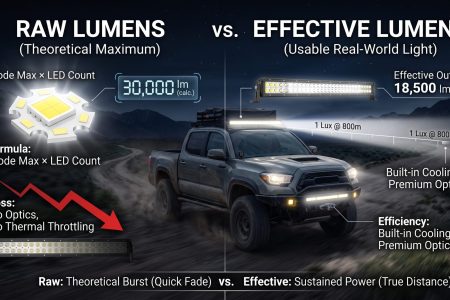
For seeing distance, look for photometric data. Useful information can include candela at specified angles, beam intensity plots, lux measured at a stated distance, horizontal and vertical beam dimensions, or an IES/LDT photometric file. The test should identify the complete lamp, input voltage, stabilized operating state, instrument, distance, and whether the value is raw emitter output or measured luminaire output. A very large lumen claim without a distribution or measured target illuminance does not reveal whether the light reaches the scene you care about.
For an amber option, ask exactly how the light is made. A tinted lens, a replaceable filter, an amber LED, and a multi-channel lamp can have different output, spectra, and durability. If the amber mode is produced by placing a filter over a white source, ask how much output is lost. If the product is dual-color, ask whether one color operates at a time or both channels can run together, how the modes are selected, and whether switching requires a separate controller or power cycle.
Check the tolerance and batch consistency. A product described as 5000 K may have a stated range; that range affects how units match if you install multiple lamps. A multi-lamp bar with color variation between segments can look uneven. Ask whether the supplier sorts LEDs into color bins, how the finished product is checked, and whether replacement modules are matched. The production and binning details are especially important when the buyer is specifying several vehicles for a fleet.
Do not confuse color standards with vehicle approvals. A CCT or CRI report does not certify that a lamp meets the beam, aim, glare, color, installation, or electromagnetic requirements applicable to a vehicle. A laboratory photometric report for a work lamp is not automatically a road-use approval. If a seller claims SAE or ECE compliance, verify the exact regulation, device category, lamp marking, approval document, country, and intended installation. The words “DOT style,” “road legal,” “E-mark ready,” and “off-road” are not interchangeable evidence.
Finally, read the installation details. Confirm the vehicle voltage range, current draw, connector, fuse, wire gauge, switch, relay requirements, mounting dimensions, thermal limits, waterproofing test conditions, and warranty. A color option that needs a different harness or controller may change system complexity. If a lamp has multiple operating modes, document which one is legal or appropriate for each setting. Beam distribution should be compared separately from the color label. For auxiliary-light types and mounting roles, see SAEC’s light bar versus driving light guide.
How can you compare light colors in the field?
A field comparison is useful only when it controls the major differences between lamps. It is not a substitute for a laboratory report, and it should never place the driver, another road user, or an observer at risk. Use a closed private area, stationary vehicle, fixed target, and a safe observer location. Do not test high-output auxiliary lights against oncoming traffic or while driving on public roads.
Begin by writing down the task. State what must be seen, how far away it is, how wide the useful area is, and what level of detail matters. “Find the recovery strap from the driver’s seat” is a defined task. “The light looks brighter” is not. Decide whether you are testing target detection, identification of a color, near-field coverage, comfort, or glare. A single visual judgment should not be presented as proof of every performance outcome.
Keep the optic, mounting place, aim, target, voltage, and operating time as constant as possible. If you compare two different products, differences in the LED, driver, reflector, lens, output, and beam shape may explain the result. For a cleaner test, use the same dual-color lamp if the modes share the same optic, or compare lamps with closely matched photometry. Measure illuminance at the task plane when that is relevant, and record the instrument, distance, angle, surface, and ambient conditions. A phone lux app can help make a rough record but is not a calibrated photometer.
Let each lamp reach a stable operating state and let the observer adapt to the scene between trials. Randomize which color appears first so that the person is not primed to prefer the mode they expected to win. If practical, have an observer who does not know which mode is being used identify a target. Use multiple target types and repeat the test. Record whether the lamp is brighter at the target, whether the hotspot moved, and whether the person recognized the object or merely saw a light patch.
Test clear weather separately from fog, rain, snow, or dust. Do not assume a clear-weather preference will survive in poor visibility. If the weather is naturally present on a closed site, record the approximate visibility and repeat under safe stationary conditions. Do not generate fog or dust around a running vehicle without a suitable controlled procedure. The aim is to assess a real task safely, not to recreate an uncontrolled research environment.
Use a short record sheet. Include date, vehicle and mounting position, lamp model, mode, input voltage, warm-up time, target, distance, beam aim, weather, surface condition, ambient light, measurement method, observer, task result, and any glare or reflection. Photographing the scene can help document setup, but cameras change white balance and exposure automatically. Lock those controls if possible and label photos as illustrative, not as photometric evidence. A picture of two light pools does not prove a particular lux value or detection distance.
The diagram below is a compact version of the process. If a test shows that one color is more comfortable, state that as an observer preference. If it produces a higher measured illuminance, name the measured point and conditions. If someone recognized a colored strap more reliably, describe that task, target, distance, and sample size. Precision in the conclusion helps prevent a personal field impression from becoming a universal claim.

When several operators share a work truck, include more than one observer. People differ in age, color vision, night vision, and visual adaptation. One operator may prefer a neutral 5000 K scene while another prefers amber for a close inspection. If the vehicle is assigned to a formal task, follow the workplace lighting and safety procedure rather than allowing a single driver’s preference to override required illumination.
Are dual-color and selectable-CCT light bars useful?
Dual-color and selectable-CCT products can be useful when the same vehicle needs more than one lighting appearance, but they introduce trade-offs. A dual-color bar may use separate white and amber LED channels, a rotating or replaceable filter, or another design. A selectable-CCT bar may mix channels to create different white points. Ask how the product achieves the modes because the method affects spectrum, output, wiring, and failure behavior.
The first technical question is whether each mode uses the same optic and beam distribution. In some products, separate LED packages or channels are placed behind one lens. The resulting beam may look similar across modes, but output and hotspot uniformity can differ. A filter-based system may preserve the optic while reducing transmission. A tunable-white system can change output as the channels are mixed. Request photometric data for each mode instead of assuming the lamp performs identically in every color.
The second question is how the mode is selected. Some lights use a separate switch, a controller, a momentary power cycle, or a memory function. A system that changes mode when power is interrupted could start in a color the operator did not intend. A separate control can be easier to manage but adds wiring and installation complexity. Check how the system behaves after the vehicle is turned off, how quickly the driver can identify the active mode, and whether it can be operated without distracting attention from driving.
The third question is what each mode is for. A white mode may be selected for general scene illumination, while an amber mode might be reserved for a particular private-site condition or visual preference. That distinction should be written in the owner’s procedure. If the vehicle may travel on public roads, do not assume that both modes are legal or that a work lamp can be switched on while moving. The intended use, color, beam pattern, mounting, and local rules all matter.
More modes do not automatically create more usable light. A vehicle with a single well-chosen beam and reliable wiring may be better than a complicated bar whose output or controls are confusing. Consider the total purchase cost, the replacement part availability, the warranty on each channel, current draw, heat, controller exposure, and how the lamp will be serviced. If a fleet manager cannot keep mode instructions consistent across operators, a fixed-color solution might be more practical.
Before purchasing, ask the seller for an operating-mode table: CCT or color in each mode, measured lumen output, input current, beam pattern, switching behavior, maximum ambient temperature, and whether simultaneous modes are supported. Also confirm that the mounting hardware and wiring are rated for the vehicle’s vibration, water, and dust exposure. If the bar is connected to a vehicle data network or camera system, verify compatibility with the vehicle manufacturer rather than assuming a new mode is only an optical change.
Compare the price of a dual-color bar with the cost of separate lamps. Separate lamps can let you aim white long-range light and amber near-field light independently, but take more mounting space and may increase wiring load. One dual-color bar simplifies the installation but places both colors at the same height and angle. The best design depends on the tasks and installation constraints, not on the number of advertised modes.
What changes when the light may be used on a road?
Road-use requirements apply to the lamp’s function, beam, color, position, marking, switching, and installation, not simply to its CCT. An off-road light bar marketed for trail use is not automatically an approved driving lamp or fog lamp. A 5000 K or 6000 K label does not demonstrate compliance with a vehicle-lighting regulation. Likewise, an amber light that an owner finds comfortable does not automatically meet the requirements for front fog lamps or other regulated equipment.
Rules differ across countries, states, provinces, and vehicle categories. The same lamp may have one status when used on private land and another when operated on a public road. Some jurisdictions specify the permitted number, color, position, aim, cover, or switching of auxiliary lamps. A lamp that is physically mounted to a vehicle may still be restricted to off-road use. Check the current local regulation and the device’s approval markings before use; a seller’s general statement may not cover the vehicle, installation, and jurisdiction.
High-output auxiliary lamps can dazzle oncoming drivers, illuminate reflective signs or mirrors, and impair the user’s own view through glare from weather or nearby surfaces. Color does not remove those risks. Use approved equipment as directed, aim it according to the manufacturer, and switch off lamps that could affect another road user. Do not use roof-mounted spotlights as headlights, and do not treat a light-bar color filter as a substitute for an approved fog-lamp optic.
Installation also has electrical and mechanical requirements. Follow the manufacturer wiring instructions; use suitable fusing, connectors, wire sizing, relay or controller equipment, and secure mounting. Verify that the lamp’s voltage range matches the vehicle. A large bar can change airflow, load a bracket, or obstruct a sensor. After installation, recheck the fasteners and aim. If the lamps flicker or interfere with vehicle electronics, diagnose the wiring and compatibility rather than changing the CCT; see SAEC’s guide to LED lighting flicker and CAN bus symptoms for a separate troubleshooting discussion.
For any public-road installation, confirm three things independently: the lamp is approved for the intended vehicle-lighting function; the way it is mounted and aimed complies with applicable rules; and the operator uses it only in permitted conditions. A product’s color metric, a successful private-site field test, a sales page, or a draft article cannot replace that confirmation. When in doubt, consult the relevant transport authority or a qualified vehicle-lighting professional before operating the equipment on a public road.
What is the final buyer checklist?
Use this LED light bar color temperature checklist before ordering a color-specific auxiliary lamp:
- Define the task. Write down the target, working distance, required detail, scene width, and whether the vehicle moves or remains stationary.
- Choose the lamp role. Decide whether you need a regulated headlamp, driving lamp, fog lamp, or off-road work light. Do not mix those categories.
- Select the beam. Compare the optic, beam plot, candela, measured lux, and aim range for the mounting location.
- Use CCT only for color appearance. Treat 5000 K and 6000 K as descriptions of white-light chromaticity, not as a rank of brightness or reach.
- Request more color data if it matters. Ask for the spectral power distribution, Duv or chromaticity tolerance, CRI/R9, or TM-30 data when target colors are important.
- Treat amber as a testable option. Confirm whether amber comes from an LED channel or a filter, and check mode-specific output and beam data.
- Compare under controlled conditions. Hold voltage, aim, target, distance, ambient light, and beam pattern constant as far as practical.
- Check the vehicle fit. Verify voltage, current, fuse, wiring, connector, mount, sensor clearance, thermal conditions, and vibration requirements.
- Confirm road-use status. Check current local rules and the exact product approval for its intended function before public-road use.
- Plan a safe verification. Test the installed light on a closed site without creating a hazard, record results, and revise aim if the beam causes glare.
Several questions can quickly reveal a weak product claim. Does the seller provide a measured beam plot or only a lumen number? Is the Kelvin value the nominal CCT of the complete fixture? Are amber and white outputs measured separately? Does “fog performance” refer to a controlled test and a specific beam? Are approval documents for the exact model available? Can the light be returned if the installed color does not suit the user? Specific answers make comparison easier and lower the chance of buying by label alone.
The product page is only the beginning of a fitment check. If you are considering a Jungle Series 40-inch straight light bar, confirm the current model specification, mounting clearance, and intended use before treating it as suitable for a particular vehicle. For a closer work-zone application, review a compact option such as the Black Pearls 2×3 heavy-duty LED work light and compare its actual beam and electrical data with the task. The product names are examples of different form factors; neither link implies a stated CCT, approval, output, or fitment that the page does not document.
For a one-lamp purchase, choose the best documented match for the main job and do not pay extra for a feature you cannot verify or will not use. For a fleet, standardize the color and mode procedure, keep technical records with each vehicle, and make sure replacement lamps match the specification. For recreational vehicles, set expectations realistically: color preference is personal, weather is variable, and no auxiliary lamp can eliminate the limits of darkness, terrain, or poor visibility.
Frequently asked questions
Is a 6000K LED light bar brighter than a 5000K one?
No. CCT describes the apparent color of a white source, not its luminous flux or intensity. A 6000 K lamp can produce less, equal, or more useful light than a 5000 K lamp. Compare the finished light’s measured output, candela or beam data, input power, optic, and test conditions. If the beam and output are closely matched, choose based on actual scene appearance and task preference rather than assuming the higher Kelvin number is brighter.
Does a 5000K light show colors better than 6000K?
Not necessarily. CCT does not reveal the full spectral power distribution, and sources with similar CCT can render colored objects differently. Check CRI, R9, or IES TM-30 information when color identification matters, then test the real materials under the installed lamp. A high color-fidelity score still does not measure beam reach, glare, or obstacle detection distance.
Does amber light always cut through fog better?
No universal result applies to every lamp and fog condition. Some studies report conditional visibility differences, but their source, beam, output, mounting, weather, and target differ from a typical off-road light bar. A lower-mounted lamp with a suitable pattern may help more than changing CCT. Treat amber as an option to compare safely for the exact task, and do not use it as a reason to drive faster in reduced visibility.
What is the difference between amber and 3000K white?
3000 K usually describes warm-looking white light, while amber is a distinct color that may come from an amber LED, a filter, or a separate channel. Their spectra can differ, and a filter can reduce output. Ask the manufacturer how the color is produced and request output and beam data for that mode. Do not assume a low-CCT white lamp and an amber lamp are interchangeable.
Is CRI important on an off-road light bar?
CRI matters most when the task depends on seeing object colors accurately, such as identifying wires, fluid, paint, straps, or colored markers. It does not tell you how far the beam reaches or whether an obstacle is visible at speed. For general trail illumination, beam distribution, aim, and measured intensity may be more important. For color-critical work, examine R9 or TM-30 data and test representative targets.
Should I buy a dual-color white and amber light bar?
A dual-color bar can be useful when the driver has two specific tasks and the controls are easy to operate. Before buying, check the output and beam in each mode, how modes are selected, whether output changes, how the bar behaves after a power cycle, and whether each mode is permitted for the intended use. Separate lamps may provide better aiming for different tasks, while a dual-color bar can simplify mounting. The better choice depends on installation and operator procedure.
Why do two lights labeled 5000K look different?
The CCT value compresses chromaticity information and does not specify every spectral feature. Products can differ in Duv, LED binning, lens tint, phosphor, driver, optics, and operating temperature. A nominal rating may also include a tolerance. Compare exact product data and, if appearance is critical, inspect the lamps side by side at the intended operating condition.
Can I use an off-road light bar as a fog lamp on public roads?
Do not assume that an off-road bar is approved for fog-lamp or road use. Legal requirements vary by jurisdiction and device category, and can cover beam pattern, color, position, markings, aim, and when a lamp may be switched on. Verify the exact product approval and local rules before using it on public roads. A low CCT or amber lens does not establish compliance.
Sources
- CIE e-ILV: Correlated colour temperature — definition of CCT and its kelvin unit.
- U.S. Department of Energy: LED Basics — LED white-light methods, CCT, color fidelity, CRI, and TM-30 context.
- U.S. Department of Energy: Color and Spectrum — CCT, spectral information, chromaticity, and Duv.
- NIST: Color rendering of light sources — CRI calculation, Ra sample averaging, and metric limitations.
- FHWA-HRT-15-047, Chapter 5: Evaluation of the Impact of Spectral Power Distribution on Driver Performance — controlled headlamp color-filter comparison and reported transmission difference.
- Applied Ergonomics study record: Road lighting color temperature and night-fog visibility — laboratory roadway-lighting study with condition-specific findings.
- SAE Technical Paper 2000-01-0434: Front Fog Lamp Performance — fog visibility factors including beam pattern, mounting height, and aim.
 by
